
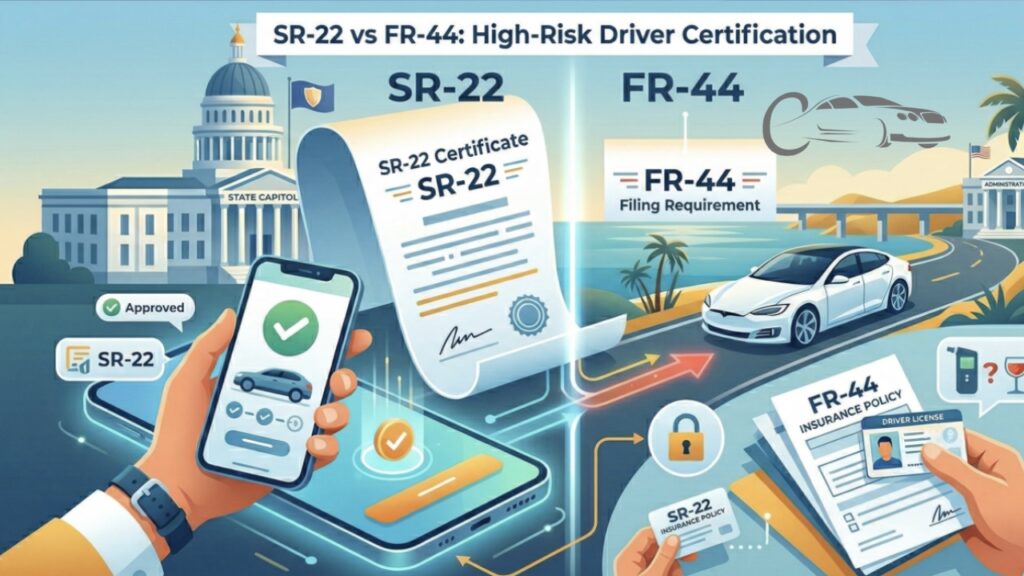
A Complete Guide for Drivers Navigating High-Risk Insurance Requirements.
If you have recently had a serious traffic violation, a DUI conviction, or a license suspension, you have probably heard someone mention an SR-22 or an FR-44. These two terms can feel confusing and even a little alarming when you first encounter them, especially because they arrive at an already stressful time in your life.
The good news is that neither one is as complicated as it sounds. Both are simply certificates that your insurance company files with your state on your behalf. They prove that you carry at least the minimum required liability coverage after certain violations. The bad news, at least for drivers in specific states who have committed specific offenses, is that one of them (the FR-44) comes with significantly higher coverage requirements and costs.
This guide walks you through everything you need to know about both certificates: what they are, who needs them, which states use them, how much they typically cost, what happens if you let them lapse, and how to eventually move on from them.
What Is an SR-22?
An SR-22 is a Certificate of Financial Responsibility. Despite what many people assume, it is not an insurance policy. It is a document that your auto insurance company files directly with your state department of motor vehicles to certify that you currently hold a valid liability insurance policy that meets or exceeds your state’s minimum coverage requirements.
Think of it less like a product you purchase and more like a report card your insurer submits on your behalf. The state wants proof that you are financially responsible behind the wheel, and the SR-22 is how that proof gets delivered.
The name sounds technical, but the process is relatively simple. You contact your insurance provider, request that they add an SR-22 filing to your policy, and they send the certificate to your state electronically or by mail. Most insurers charge a one-time filing fee that typically falls between $15 and $50. That fee is modest, but the underlying policy cost tends to rise because insurers now categorize you as a high-risk driver.
Who Typically Needs an SR-22?
States require SR-22 filings after a variety of violations and circumstances. The most common triggers include:
- A DUI or DWI conviction (in most states outside of Florida and Virginia)
- Driving without insurance or being caught in an at-fault accident while uninsured
- Receiving too many points on your license within a short period
- Having your license suspended or revoked for reasons other than serious DUI offenses
- Certain reckless driving convictions
- A first offense DUI in states that have not adopted the FR-44 standard
- Court-ordered requirements following certain criminal traffic violations
In most states, the SR-22 requirement lasts three years from the date of the incident or from the date your license is reinstated, depending on how your state calculates it. Some states require it for as few as two years, and others for up to five, so it is always worth confirming the specific timeframe with your state DMV.
SR-22 for Non-Owners
If you do not own a vehicle but still need to drive, there is a variation called a non-owner SR-22. This type of policy covers you when you drive vehicles you do not own, such as a rental car or a friend’s car. It satisfies the SR-22 requirement without tying you to a specific vehicle, which makes it a practical and often cheaper option for people between cars.
Read also: SR‑22 Insurance Explained: Illinois Guide
What Is an FR-44?
The FR-44 is a Certificate of Financial Responsibility that serves a similar purpose to the SR-22 but with one critical distinction: it requires significantly higher liability coverage limits than a standard SR-22.
Only two states in the United States currently use the FR-44: Florida and Virginia. Both states require it specifically after DUI or DWI convictions, and in some cases after other serious alcohol or drug-related driving offenses. If you live outside of Florida or Virginia, you will likely never encounter this certificate.
The name FR-44 comes from the form itself, just as SR-22 does, and it functions in the same mechanical way. Your insurance company files it with the state to confirm your coverage. The difference is entirely in the amount of coverage it demands.
Why Does Florida and Virginia Use FR-44?
Both Florida and Virginia made a policy decision to hold drivers convicted of DUI to a stricter standard than other at-risk drivers. The reasoning is that alcohol and drug-related offenses carry a statistically higher risk of serious injury or death, and the standard minimum liability limits are often insufficient to cover the real-world costs of catastrophic accidents.
By requiring significantly higher coverage minimums, these states aim to make sure that drivers who have demonstrated extremely dangerous behavior are carrying enough insurance to actually pay for the harm they might cause. It is a stricter form of accountability.
SR-22 vs FR-44: The Core Differences
At a high level, here is how these two certificates compare across the most important categories.
| Category | SR-22 | FR-44 |
|---|---|---|
| What it is | Certificate of Financial Responsibility | Certificate of Financial Responsibility (higher limits) |
| Who files it | Your insurance company | Your insurance company |
| States that use it | Most U.S. states | Florida and Virginia only |
| Triggered by | DUI, driving uninsured, excessive points, license suspension, minor reckless driving | DUI/DWI and serious alcohol/drug driving offenses |
| Coverage requirement | State minimum liability limits | Double or more than state minimums |
| Filing fee | $15 to $50 (typical) | $15 to $50 (typical) |
| Premium impact | Moderate to significant increase | Significant to very large increase |
| Duration | 1 to 5 years (usually 3) | 3 years in most cases |
| Non-owner version available | Yes | Yes |
| Can lapse without penalty | No, triggers suspension | No, triggers suspension |
Coverage Requirements: Where the Real Difference Lives
The most impactful difference between an SR-22 and an FR-44 is in the liability coverage minimums. To understand why this matters, you first need to know how liability coverage works.
Standard auto liability insurance is typically written as three numbers, such as 25/50/10. The first number is the maximum your insurer will pay per person injured in an accident you cause (in thousands of dollars). The second number is the maximum per accident across all injured people. The third is the maximum for property damage. So 25/50/10 means $25,000 per person, $50,000 per accident, and $10,000 for property damage.
Here is how the coverage requirements stack up across different scenarios:
| State / Scenario | Standard Minimum Liability | SR-22 Minimum Liability | FR-44 Minimum Liability |
|---|---|---|---|
| Florida (general) | 10/20/10 | 10/20/10 | 100/300/50 |
| Virginia (general) | 30/60/20 | 30/60/20 | 50/100/40 |
| Typical SR-22 state (e.g., California) | 15/30/5 | 15/30/5 | N/A (no FR-44) |
| Typical SR-22 state (e.g., Texas) | 30/60/25 | 30/60/25 | N/A (no FR-44) |
| Typical SR-22 state (e.g., Illinois) | 25/50/20 | 25/50/20 | N/A (no FR-44) |
Notice what happens in Florida. A standard driver can legally drive with $10,000 in property damage coverage. A driver convicted of DUI under an FR-44 requirement must carry $50,000 in property damage coverage. That is a fivefold increase. The bodily injury coverage jumps from $10,000 per person to $100,000 per person, a tenfold increase. These are not minor adjustments. They are a fundamentally different level of financial protection, and they come at a corresponding cost.
In Virginia, the jump is less dramatic but still substantial. Property damage goes from $20,000 to $40,000, and bodily injury coverage per person rises from $30,000 to $50,000. Virginia also requires FR-44 in some cases involving driving with a suspended license if it was suspended due to DUI.
The Cost Reality: What You Should Actually Expect to Pay
Let’s be honest about what these requirements do to your insurance bill. The filing fee itself is minor, but the story does not end there.
SR-22 Cost Breakdown
An SR-22 filing typically costs between $15 and $50 as a one-time fee paid to your insurer. However, your annual premium will rise because you are now flagged as a high-risk driver. Depending on your state, your driving history, your age, and the specific violation, you can expect your premium to increase anywhere from 30% to 100% or more.
For context, a driver who was paying $1,200 per year might find themselves paying $1,800 to $2,400 annually after an SR-22 requirement kicks in. That spread adds up over a three-year requirement period.
| Driver Profile | Estimated Annual Premium (Before) | Estimated Annual Premium (After SR-22) | Estimated 3-Year Total Increase |
|---|---|---|---|
| Clean record baseline | $1,200 | $1,200 (no change) | $0 |
| SR-22 after minor DUI (first offense) | $1,200 | $2,100 to $2,800 | $2,700 to $4,800 |
| SR-22 after driving uninsured | $1,200 | $1,600 to $2,200 | $1,200 to $3,000 |
| SR-22 after license suspension (points) | $1,200 | $1,500 to $2,000 | $900 to $2,400 |
These are illustrative estimates. Actual premiums vary widely based on insurer, state, age, marital status, credit score (where allowed), and the severity and recency of the violation. Shopping around between multiple insurers is genuinely important here because rate differences can be substantial.
FR-44 Cost Breakdown
The FR-44 situation is more expensive, and significantly so. Because the required coverage levels are so much higher, the premium increase is not just a flat risk surcharge. You are also paying for a fundamentally larger insurance policy. Add the high-risk flag on top of that, and the cost impact can feel severe.
| Driver Profile (Florida FR-44) | Estimated Annual Premium (Before) | Estimated Annual Premium (After FR-44) | Estimated 3-Year Total Increase |
|---|---|---|---|
| Clean record baseline in Florida | $1,400 | $1,400 (no change) | $0 |
| FR-44 after first DUI conviction | $1,400 | $3,500 to $5,500 | $6,300 to $12,300 |
| FR-44 after second DUI conviction | $1,400 | $6,000 to $10,000+ | $13,800 to $25,800+ |
| FR-44 non-owner policy (no vehicle) | $0 | $1,200 to $2,500/year | $3,600 to $7,500 |
These numbers represent a serious financial commitment. For many drivers, the cost of maintaining an FR-44 policy for three years can rival the cost of a used car. This is intentional. States have designed the requirement with the understanding that financial accountability should be meaningful for drivers who have committed dangerous alcohol-related offenses.
What Happens If Your Coverage Lapses?
This is the part of the SR-22 and FR-44 story that trips up a lot of drivers, and the consequences can snowball quickly if you are not careful.
Both certificates come with a continuous coverage requirement. That means you cannot let your policy expire, cancel it, or fail to make a payment without triggering an automatic notification to the state. When your insurer receives notice that your coverage has lapsed, federal regulations require them to notify your state DMV by filing an SR-26 or FR-46 form, which is the cancellation version of the original certificate.
What Happens After a Lapse
The moment your state DMV receives that cancellation notice, the following sequence of events typically begins:
- Your driving privileges are immediately suspended or revoked
- Your reinstatement period resets, meaning the clock on your SR-22 or FR-44 requirement may start over from the beginning
- You may face additional fines and fees to reinstate your license
- In some states, a lapse can trigger additional legal consequences, including mandatory court appearances
- You will need to obtain new coverage and file a new certificate before you can legally drive again
The practical lesson here is straightforward. If money is tight and you are tempted to let your policy lapse to save a few hundred dollars for a month, the cost of that decision almost always dwarfs whatever you saved. Suspension reinstatement fees, court costs, and the reset requirement period can easily add thousands of dollars to your total burden.
If you genuinely cannot afford your current policy, the wiser move is to call your insurer and ask about payment plans, or shop for a more affordable policy with a different carrier before your current one cancels. Many insurers will work with you to avoid a lapse because they also want to keep the relationship.
State-by-State Overview: Which States Use Which Certificate
Understanding which states use SR-22 and which use FR-44 helps you know what to expect if you are moving between states or if your violation occurred in a different state than where you currently reside.
| Certificate Type | States | Notes |
|---|---|---|
| FR-44 | Florida, Virginia | Required after DUI/DWI. Higher coverage minimums. Other states use SR-22 even for DUI. |
| SR-22 (standard) | Most remaining U.S. states including CA, TX, NY, IL, OH, PA, AZ, GA, NC, WA, and others | Required after various violations including DUI. Uses standard state minimums. |
| No SR-22 required | Delaware, Kentucky, Minnesota, New Mexico, Oklahoma, Pennsylvania (in some contexts) | Some states handle high-risk monitoring differently or have alternative programs. Always verify with your state DMV. |
A note on states that do not require SR-22: they often have other mechanisms for monitoring high-risk drivers or may still require proof of insurance through different administrative channels. If you live in one of these states and have had a serious violation, contact your DMV directly to understand your obligations.
What If You Move States?
Moving to a different state while you are under an SR-22 or FR-44 requirement is more complicated than it might seem. Your home state requirement does not automatically follow you. However, your new state may impose its own requirements once you register your vehicle and transfer your license there.
Importantly, you cannot simply move to escape the requirement in your original state if you still have a license there. Many states have reciprocal notification systems, and driving with a suspended license in any state is a serious offense that compounds your problems. The safest approach is to contact both your original state’s DMV and your new state’s DMV, and speak with an attorney or knowledgeable insurance agent before making assumptions about your obligations.
How Long Do You Need to Carry These Certificates?
The required duration for both SR-22 and FR-44 certificates varies by state and by the nature of the offense.
| Certificate | Typical Duration | When the Clock Starts | What Resets the Clock |
|---|---|---|---|
| SR-22 (most states) | 3 years | Date of conviction or license reinstatement (varies by state) | Coverage lapse, additional violations, failure to comply with court requirements |
| SR-22 (some states) | 2 to 5 years | Varies by state law and severity of offense | Same as above |
| FR-44 (Florida) | 3 years | Date of conviction | Coverage lapse, additional DUI conviction, or failure to maintain required limits |
| FR-44 (Virginia) | 3 years | Date of conviction or license restoration | Coverage lapse, new DUI conviction |
Three years is the most common duration and reflects the standard actuarial window insurers and states use to assess whether a driver has demonstrated a sustained change in behavior. Once your requirement period ends, you are not required to maintain the certificate, though some drivers choose to keep higher coverage limits voluntarily because their situation has changed and their assets are now worth protecting.
How to Obtain an SR-22 or FR-44
The process for getting either certificate is similar and generally not complicated, though it does require finding an insurer willing to cover high-risk drivers.
Step by Step
- Contact your current insurer first and ask if they offer SR-22 or FR-44 filing. Many standard insurers do, though some will non-renew your policy after a serious violation.
- If your current insurer cannot help, shop for coverage with carriers that specialize in high-risk auto insurance. Companies like Progressive, The General, Dairyland, and State Farm often work with SR-22 and FR-44 drivers, though availability varies by state.
- Purchase a policy that meets or exceeds the required minimums for your certificate type. For an FR-44, make sure the policy meets the elevated limits, not just the standard state minimums.
- Pay the filing fee, usually $15 to $50, and your insurer will submit the certificate to your state DMV, typically within a few days.
- Keep copies of the certificate for your records and confirm with your DMV that it has been received and accepted.
- Set up automatic payments or calendar reminders to ensure you never miss a premium payment during the requirement period.
One important note: some insurers that specialize in high-risk coverage charge higher rates than others, and the market varies significantly by state. Taking two or three hours to compare quotes from multiple providers can save you hundreds or even thousands of dollars over a three-year period. Do not simply accept the first quote you receive.
SR-22 and FR-44 Penalties for Violations: What the State Can Do
The penalties for failing to maintain your SR-22 or FR-44 coverage, or for violating the terms of the requirement, are serious. Here is a summary of what various states may impose.
| Violation | Typical Penalty | SR-22 Specific | FR-44 Specific |
|---|---|---|---|
| Coverage lapse (first time) | License suspension, reinstatement fee of $50 to $500 | Requirement period may restart | Requirement period restarts in Florida and Virginia |
| Driving without required certificate | Additional fines ($200 to $1,000+), potential arrest, extended suspension | Same as standard uninsured driving penalties plus SR-22 extension | Enhanced penalties due to prior DUI conviction history |
| Failure to carry required limits (FR-44 specific) | N/A for SR-22 | N/A | Treated as coverage lapse, license suspended, period restarts |
| Additional DUI conviction during period | New criminal charges, extended suspension, significantly higher premiums | New SR-22 period begins, compounding violations on record | New FR-44 period begins, insurer may refuse to renew |
| Lying about SR-22 or FR-44 status | Insurance fraud charges, criminal penalties, permanent record impact | Applicable | Applicable |
| Moving out of state without notifying DMV | Original state suspension remains active, new state violations possible | Applicable | Applicable |
The theme running through all of these penalties is that they compound. A single lapse can transform a three-year obligation into a four or five year one once you account for the reset period, the additional fees, and the new policy requirements. Staying current and compliant is almost always the less expensive path, even when it requires sacrifice.
The Impact on Your Insurance History and Driving Record
Beyond the certificate itself, a DUI or serious traffic violation leaves a mark on both your driving record and your insurance history. Understanding how long these marks last helps you plan for when your situation will genuinely improve.
Driving Record
Traffic violations stay on your driving record for varying lengths of time depending on your state and the severity of the violation. A DUI conviction typically stays on your record for five to ten years in most states. Some states, like California, keep a DUI on your record for ten years. A few states maintain DUI records permanently.
Your driving record is what insurers check when calculating your premium. As long as the violation appears on it, you will typically pay higher rates even after your SR-22 or FR-44 requirement has ended. This is an important distinction: the certificate requirement ending does not mean your insurance rates immediately drop back to pre-violation levels.
Insurance History
The Comprehensive Loss Underwriting Exchange, commonly called CLUE, is a database that insurance companies use to share claims and policy information. An SR-22 or FR-44 requirement will be visible to future insurers when they check your history. This visibility typically lasts five to seven years.
Practically, this means that even after your driving record clears and your certificate requirement ends, some standard market insurers may decline to cover you or may charge elevated rates for a period beyond the certificate years. Shopping around remains important even after your formal obligation ends.
When Things Actually Get Better
Here is the realistic timeline for when a DUI-related SR-22 or FR-44 situation starts to genuinely improve:
- Year 1: Certificate in place, rates at their highest, restricted driving situation
- Year 2 to 3: Coverage in force, rates may stabilize, driving record still shows violation prominently
- Year 3 to 4: Certificate requirement ends (depending on state), rates may begin declining
- Year 5 to 7: DUI begins to age off driving record in many states, more favorable insurance rates become accessible
- Year 7 to 10: Most standard market insurers begin treating you more like a standard driver
This is a long road, but it is a finite one. Drivers who comply, maintain coverage, and avoid subsequent violations do get through it.
Tips for Managing the Cost and Process
Dealing with an SR-22 or FR-44 requirement is stressful, but there are practical ways to manage the financial impact and navigate the process more effectively.
Shop Aggressively for Insurance
This is the single most impactful thing you can do. High-risk insurance rates vary enormously between carriers. Getting quotes from five or more insurers before settling on one can save you hundreds of dollars per year. Specialty high-risk carriers like Dairyland, The General, Gainsco, and others sometimes offer more competitive rates than standard carriers for certain violation profiles.
Consider a Non-Owner Policy
If you do not currently own a vehicle and can manage without one for a period, a non-owner SR-22 or FR-44 policy satisfies the certificate requirement at a lower cost because it does not cover a specific vehicle. This approach works well for people who primarily use public transit, ride-sharing, or can borrow vehicles sparingly.
Improve Other Risk Factors
Insurers use multiple factors to calculate premiums beyond your driving violations. Improving your credit score (where legal to use), completing a defensive driving course, bundling your auto policy with homeowners or renters insurance, and maintaining continuous coverage history all work in your favor. Some of these improvements can partially offset the violation-related surcharge.
Ask About Discounts
Even high-risk insurers offer discounts. Ask specifically about low-mileage discounts if you drive fewer miles than average, occupation discounts, multi-policy discounts, and discounts for completing state-approved DUI education programs. These programs are often required as part of a DUI sentence anyway, so confirming their impact on your premium is worthwhile.
Never Miss a Payment
Set up automatic payments if at all possible. A missed payment that lapses your coverage resets your requirement period and adds fees that dwarf whatever temporary savings resulted from the missed payment. Treat your premium payment as a non-negotiable monthly obligation during the certificate period.
Common Misconceptions About SR-22 and FR-44
A few widespread misunderstandings about these certificates cause unnecessary confusion and sometimes costly mistakes.
Misconception 1: SR-22 and FR-44 Are Insurance Policies
They are not. They are certificates that prove you have an insurance policy. You cannot buy an SR-22 directly. You buy an insurance policy, and your insurer files the certificate on your behalf. The distinction matters because if your insurer files an SR-22 but your underlying policy does not meet the required minimums, the certificate is invalid.
Misconception 2: You Can Switch Insurers Without Worrying About a Gap
Switching insurers while under a certificate requirement requires careful coordination. You need to make sure your new policy and new certificate filing are in place before your old policy cancels. Even a one-day gap can trigger the lapse notification to the DMV. Coordinate directly with both your old and new insurer and ask specifically about the transition timeline.
Misconception 3: Once Your Requirement Ends, Your Rates Go Back to Normal
As discussed above, your rates will likely improve once the certificate requirement ends, but they will not instantly return to pre-violation levels. The violation still appears on your driving record, and the CLUE database still reflects your history. Gradual improvement over five to seven years is more realistic than an immediate reset.
Misconception 4: Only DUI Convictions Require SR-22
DUI is the most common trigger, but far from the only one. Driving without insurance, accumulating excessive points, reckless driving in many states, and various other violations can all trigger SR-22 requirements depending on your state. Check your state’s specific violation list if you are unsure whether your situation qualifies.
Misconception 5: FR-44 Is Just a More Expensive SR-22
While the core mechanism is the same, the FR-44 is not just a pricier version of the SR-22. It exists in only two states, applies only to serious DUI offenses, and requires coverage levels so much higher that it represents a fundamentally different financial obligation. The underlying insurance product, the way it is filed, and the lapse consequences are all handled the same way, but the coverage minimums make the practical experience quite different.
Frequently Asked Questions
Do I need an SR-22 if I don’t own a car?
Yes, you can get a non-owner SR-22 policy that satisfies the requirement without being tied to a specific vehicle.
How long does it take for an SR-22 to be filed with the state?
Most insurers file electronically and the state receives it within one to three business days.
Can my insurance company drop me after requiring an SR-22?
Yes, some standard carriers will non-renew your policy after a serious violation, which means you will need to find a high-risk specialist insurer.
Does an SR-22 follow me if I move to a different state?
Your original state’s requirement stays active, but you may also face new requirements from your new state once you establish residency and register there.
Is there a difference between an SR-22 and an SR-22A?
The SR-22A is used in a few states like Texas for drivers who have had multiple violations or who need to pre-pay for coverage rather than paying monthly.
Can I remove an FR-44 requirement early?
Generally no, the requirement period is fixed by law and begins on the date of conviction, though you should confirm your specific end date with your state DMV.
Will an SR-22 requirement show up on a background check?
Not typically on a standard employment background check, but it will appear on your driving record, which employers who require driving may check.
Do I need to carry the SR-22 certificate in my car?
No, the certificate is on file with the DMV and your insurer; you do not need a physical copy in your vehicle.
What happens if I move from Florida to another state while under an FR-44?
Florida’s requirement still applies as long as you hold a Florida license, so you need to coordinate with both states and maintain the required coverage until the Florida requirement officially ends.
Can I still get car insurance with an SR-22 or FR-44 on my record?
Yes, while some standard market insurers may decline, many carriers specifically serve high-risk drivers and can provide coverage with a certificate filing.
Does the SR-22 or FR-44 affect my credit score?
The certificate itself does not affect credit, though the underlying violation may be visible during certain types of background checks that go beyond standard credit inquiries.
How do I know when my SR-22 or FR-44 requirement ends?
Contact your state DMV with the specific date of your conviction or reinstatement and they can confirm the exact end date for your requirement.
Final Thoughts
An SR-22 or FR-44 requirement is not the end of the road. It is a formal accountability measure that states use to ensure drivers with serious violations are carrying meaningful insurance coverage while they rebuild their record. Yes, it costs more money. Yes, it comes with strict compliance rules. But it is a manageable situation with a defined end point.
The drivers who come through it best are the ones who treat the requirement as a structured obligation rather than a punishment to fight against. They stay current on payments, shop for the best available rate, avoid subsequent violations, and use the time to genuinely reconsider their habits behind the wheel.
If you are facing an SR-22 requirement, the path forward is clear: find coverage, file the certificate, maintain it without interruption, and wait out the three-year clock. If you are in Florida or Virginia facing an FR-44, the same advice applies, though the financial impact is heavier and the importance of shopping aggressively for coverage is even greater.
Most people who go through this process emerge with a cleaner record, a better understanding of how auto insurance actually works, and a renewed appreciation for the value of driving carefully. That outcome is worth more than the years of elevated premiums cost.
This article is for informational purposes only and does not constitute legal or insurance advice.
Always consult your state DMV and a licensed insurance professional for guidance specific to your situation.