
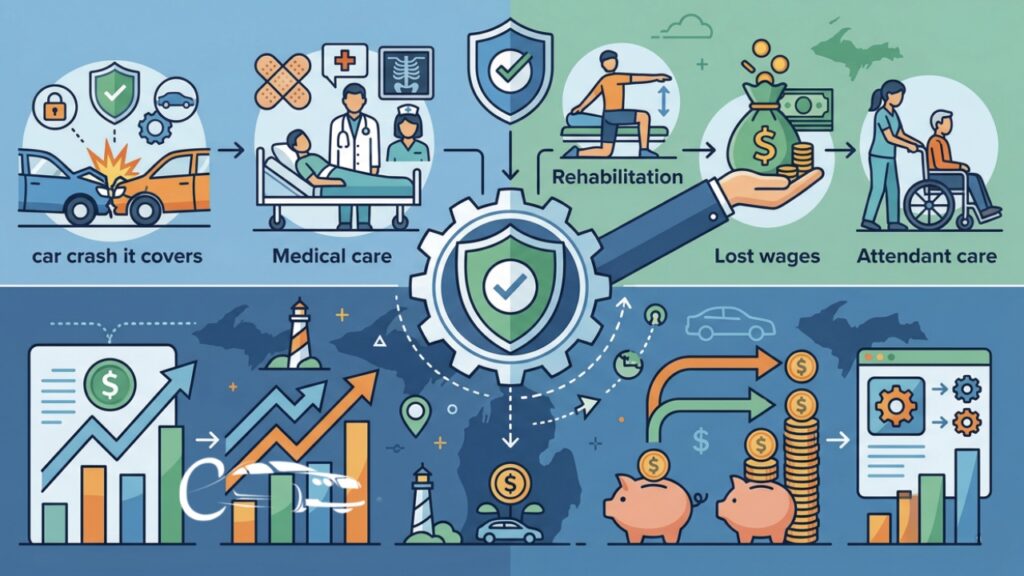
If you drive in Michigan, Personal Injury Protection isn’t just a line item on your insurance quote — it’s the financial backbone of the entire system. Michigan runs on no-fault insurance, and PIP is the engine that makes it work. It pays your medical bills, your lost wages, and in some cases even your household help costs, all without waiting for anyone to determine who caused the accident.
But here’s what makes Michigan different from every other no-fault state in the country: you get to choose your PIP limit. Since 2020, Michigan drivers have been able to select from a tiered menu of coverage levels — from unlimited lifetime benefits down to a $50,000 cap — and that single decision can be one of the most consequential financial choices you make. Choose wrong, and the savings on your premium could cost you everything in a serious crash.
This guide breaks down everything Michigan drivers need to know about PIP insurance in 2026: what it actually covers, what each tier costs, who qualifies for what, and how to make the right call for your specific situation.
Table of Contents
- What Is PIP Insurance in Michigan?
- Is PIP Required in Michigan?
- What Does Michigan PIP Cover?
- Michigan PIP Coverage Tiers Explained
- The Qualified Health Coverage Rule
- How Much Does PIP Insurance Cost in Michigan?
- Michigan PIP Rates by City
- Best Insurance Companies for Michigan PIP in 2026
- How to File a PIP Claim in Michigan
- The 2020 Reform: How Michigan PIP Changed and Why It Matters
- What PIP Does NOT Cover in Michigan
- Who Is Covered Under Your Michigan PIP Policy?
- Michigan PIP vs. Bodily Injury Liability: The Difference
- The MCCA: Why Michigan PIP Costs What It Does
- How to Choose the Right PIP Tier
- How to Lower Your PIP Premium Without Risking Your Coverage
- Frequently Asked Questions
- Final Takeaway
What Is PIP Insurance in Michigan?
Personal Injury Protection is a form of first-party auto insurance coverage. “First-party” means it pays benefits directly to you — the policyholder — rather than to someone you may have injured in a crash. That distinction is the entire premise behind Michigan’s no-fault system.
In a traditional at-fault state, if someone hits you, you file a claim with their insurer, wait for liability to be accepted, and navigate a process that can take months. Michigan eliminated most of that waiting game for medical expenses. After an accident — regardless of who caused it — your own PIP coverage pays your bills immediately.
Michigan has operated under a mandatory no-fault PIP framework since 1973. For nearly 50 years, the system had a single PIP option: unlimited lifetime medical benefits. That changed with Public Acts 21 and 22 of 2019, which took effect in July 2020 and fundamentally restructured how PIP works. Drivers now must affirmatively choose a coverage tier — and that choice carries serious consequences.
Is PIP Required in Michigan?
Yes, and there are no exceptions based on financial hardship or personal preference.
Under the Michigan No-Fault Insurance Act (MCL 500.3101), every owner or registrant of a motor vehicle required to be registered in Michigan must maintain a no-fault insurance policy that includes PIP coverage. The only drivers who can waive PIP entirely are those who are enrolled in Medicare — and even then, specific eligibility conditions apply.
If you let your PIP coverage lapse, Michigan law treats it the same as driving uninsured. You face license and registration suspension, fines, and exposure to full financial liability in the event of an accident.
What Does Michigan PIP Cover?
Michigan PIP is among the broadest first-party auto coverage in the country. Here is what it pays for:
Medical Expenses
PIP covers 100% of all reasonable and necessary medical expenses resulting from an auto accident — up to your selected coverage limit. This includes emergency room visits, hospitalization, surgeries, physical therapy, prescription medications, prosthetics, and long-term rehabilitative care.
This is a critical distinction from Florida’s PIP, which only covers 80% of medical costs. Michigan’s PIP covers the full amount of your medical bills with no co-pay requirement from the insured, though the bills must be “reasonable and customary” under the fee schedule set by the Michigan Department of Insurance and Financial Services.
Lost Wages
If your injuries prevent you from working, Michigan PIP reimburses 85% of your gross lost income, subject to a statutory maximum that adjusts annually. For 2026, that cap is $6,615 per month for up to three years from the date of the accident.
This is one of the more generous lost wage replacement rates among no-fault states — most states cap at 60%. The three-year window is a meaningful limitation, however. If your injuries result in a permanent inability to work, PIP’s wage benefit eventually expires even under the unlimited medical tier.
Replacement Services
This is one of Michigan PIP’s lesser-known but practically significant benefits. If your injuries prevent you from performing ordinary household tasks — cooking, cleaning, lawn care, childcare, grocery shopping — PIP pays for someone else to perform those services for you. The statutory rate is up to $20 per day for a maximum of three years.
At $20 per day, this benefit doesn’t fully cover professional home care costs in most markets. But it provides a meaningful offset, particularly during recovery periods where families are absorbing sudden caregiving costs.
Attendant Care
For serious injuries requiring around-the-clock assistance, Michigan PIP covers attendant care — in-home nursing or personal care services provided by a licensed professional or even a family member. This is one of the areas where unlimited PIP coverage has historically made the greatest difference. Catastrophic injuries can require attendant care that costs hundreds of thousands of dollars per year, indefinitely.
Under tiered coverage levels, attendant care is still covered but is subject to the elected limit. A driver who chooses $250,000 in PIP and then sustains a spinal cord injury requiring 24-hour care may exhaust their entire PIP benefit within two to three years of the accident.
Death Benefits
Michigan PIP includes a funeral and burial expense benefit of up to $5,367 (adjusted annually) payable upon the death of a covered person from an accident-related injury. This benefit is separate from any survivor wage loss benefits or wrongful death claims.
Michigan PIP Coverage Tiers Explained
This is the decision that defines your entire Michigan insurance policy. Since the 2020 reform, you must choose from the following tiers:
| PIP Tier | Coverage Limit | Who Can Select This |
|---|---|---|
| Unlimited | No cap on lifetime medical benefits | Any Michigan driver |
| $500,000 per person | Capped at $500,000 | Any Michigan driver |
| $250,000 per person | Capped at $250,000 | Any Michigan driver |
| $250,000 with exclusion | $250,000, with named individual excluded | Drivers with a household member who has Medicare or Medicaid |
| $50,000 per person | Capped at $50,000 | Medicaid-enrolled drivers only |
| PIP Opt-Out | No PIP medical coverage | Medicare-eligible drivers only |
Understanding What “Capped” Actually Means
The word “limit” sounds straightforward, but its implications are not. A $250,000 PIP cap means that once $250,000 in medical benefits has been paid — whether over three months or ten years — your PIP policy pays nothing further. Any ongoing medical costs become your personal financial responsibility, regardless of how long your recovery takes.
For minor accidents, even the $50,000 tier is rarely exhausted. But for serious crashes involving traumatic brain injuries, spinal damage, or amputations, $250,000 can disappear in under a year. Unlimited coverage ensures that no matter how severe the injury, your medical care is covered for life.
The Unlimited PIP Tier: Still the Gold Standard
Despite the reform’s intent to give drivers more affordable options, unlimited PIP remains the benchmark for good reason. Michigan’s catastrophic claims history — the reason the MCCA surcharge exists — demonstrates what serious auto accidents can actually cost. Long-term attendant care for a catastrophic injury can run $300,000 to $500,000 per year. Unlimited coverage eliminates the risk of exhausting your benefit while still in active recovery.
If you do not have robust employer-sponsored health insurance that explicitly covers auto accident injuries without exclusions or sub-limits, downgrading from unlimited PIP requires careful consideration.
The Qualified Health Coverage Rule
Michigan law allows drivers to select reduced PIP tiers — or opt out entirely — only if they have what the state defines as Qualified Health Coverage (QHC). This is not the same as simply having health insurance.
For the period July 1, 2025 through June 30, 2026, your health insurance qualifies as QHC only if its annual deductible does not exceed $6,579. If your health plan’s deductible is higher than this amount — which is increasingly common with high-deductible health plans — you do not qualify for reduced PIP tiers, regardless of any other coverage terms.
This catches thousands of Michigan drivers off guard every year. A driver who selects the $250,000 PIP tier based on the assumption that their health insurance will cover the rest may discover — after an accident — that their health plan’s deductible, exclusions, or benefit limits leave them substantially exposed.
Before selecting any tier below unlimited, review your health insurance policy’s specific terms regarding auto accident coverage, not just its deductible amount.
How Much Does PIP Insurance Cost in Michigan?
Michigan is one of the most expensive auto insurance states in the country, and PIP is a primary reason why. Here are the average monthly costs by tier for 2026:
| PIP Tier | Estimated Monthly Cost (PIP portion only) |
|---|---|
| Unlimited | $120 – $200+ |
| $500,000 | $90 – $150 |
| $250,000 | $70 – $120 |
| $50,000 (Medicaid only) | $40 – $70 |
| Opt-Out (Medicare only) | $0 – $30 (administrative fees may apply) |
These figures represent the PIP component of your premium only — your full policy will include additional costs for Property Protection Insurance, residual liability, and any optional coverages you elect.
How Much of Your Total Premium Is PIP?
PIP accounts for roughly 40% to 50% of the total cost of a Michigan no-fault auto insurance policy. This means that if your full policy costs $300 per month, approximately $120 to $150 of that is your PIP coverage. Downgrading from unlimited to the $250,000 tier might save you $30 to $60 per month — $360 to $720 annually — but it transfers significant financial risk back to you.
How Does Michigan’s PIP Cost Compare to Other States?
No-fault states like Florida require a minimum of $10,000 in PIP, which typically adds $50 to $80 per month to a policy. Michigan’s unlimited tier costs two to three times more — but provides coverage that is categorically different in scope. Florida PIP covers 80% of up to $10,000 in medical costs. Michigan’s unlimited tier covers 100% of medical costs, indefinitely, with no ceiling.
Michigan PIP Rates by City
Where you live in Michigan has an enormous effect on what you pay for PIP. Detroit has historically been one of the most expensive cities in the entire country for auto insurance, largely due to a high volume of claims, litigation rates, and fraud-related costs that have driven insurer losses for decades. The 2020 reform was partly designed to address this — and rates in Detroit have come down meaningfully — but urban Michigan still costs significantly more than rural Michigan.
Here is a snapshot of estimated average monthly PIP costs (unlimited tier) by city for 2026:
| City | Estimated Monthly PIP Cost (Unlimited) |
|---|---|
| Detroit | $180 – $260 |
| Flint | $140 – $200 |
| Lansing | $100 – $150 |
| Grand Rapids | $90 – $135 |
| Ann Arbor | $85 – $130 |
| Kalamazoo | $80 – $120 |
| Traverse City | $65 – $95 |
| Upper Peninsula (rural) | $55 – $85 |
Detroit’s rates remain elevated even post-reform because the underlying claims environment hasn’t changed as dramatically as the legislation intended. Fraud, inflated medical billing, and a backlog of legacy litigation still affect how insurers price risk in Wayne County. If you live in Detroit and are paying significantly more than these estimates, it is worth getting quotes from multiple carriers — the spread between the cheapest and most expensive insurer in Detroit can be $1,500 or more annually for the same driver and coverage level.
For drivers in Grand Rapids, Ann Arbor, or the Upper Peninsula, Michigan PIP is meaningfully more affordable, and the case for maintaining unlimited coverage becomes even easier to justify on a cost basis.
Best Insurance Companies for Michigan PIP in 2026
Not all insurers price Michigan PIP the same way. Beyond just the base premium, insurers differ in how they handle claims, how aggressively they pursue fraud defenses that can delay your own PIP benefits, and what discounts are available. Here is how the major carriers stack up for Michigan PIP specifically:
| Insurer | Best For | Avg. Monthly Full Coverage | PIP Claims Handling |
|---|---|---|---|
| USAA | Military families | $130 – $175 | Excellent |
| Auto-Owners Insurance | Overall value | $145 – $195 | Very Good |
| Frankenmuth Mutual | Michigan-specific expertise | $150 – $200 | Very Good |
| Erie Insurance | Customer service | $155 – $210 | Good |
| Progressive | High-risk drivers | $160 – $230 | Good |
| State Farm | Bundling discounts | $165 – $235 | Good |
| Allstate | Tech-forward features | $175 – $250 | Average |
| Hanover Insurance | Rural Michigan drivers | $140 – $185 | Good |
USAA consistently earns the highest marks for claims satisfaction but is only available to active military members, veterans, and their immediate families. If you qualify, it is almost always worth getting a USAA quote before deciding on any other carrier.
Frankenmuth Mutual deserves special mention because it is a Michigan-based insurer with deep familiarity with the state’s no-fault system. Michigan-specific carriers often handle PIP claims more efficiently than national insurers who treat Michigan as an edge case in their broader book of business.
Auto-Owners Insurance is consistently one of the more competitively priced options for Michigan drivers with clean records, and its claims reputation in the state is strong.
One important practical note: when evaluating insurers for Michigan PIP, ask specifically how they handle attendant care disputes. This is one of the most commonly litigated areas of Michigan PIP — insurers sometimes contest the number of hours or the rate paid for attendant care provided by a family member. An insurer with a history of aggressive PIP dispute practices can turn a claim that should be straightforward into a protracted legal fight.
How to File a PIP Claim in Michigan
Filing a PIP claim in Michigan is different from filing a standard auto insurance claim in most other states. Because PIP is first-party coverage, you are filing with your own insurer — not the other driver’s. Here is how the process works step by step.
Step 1: Seek Medical Attention Immediately
This is not just medical advice — it is legally relevant. Michigan PIP requires that your medical treatment be reasonable and necessary. Gaps in treatment can give insurers grounds to dispute whether your ongoing costs are related to the accident. If you are injured, get evaluated by a physician as soon as possible, even if your injuries feel minor.
Step 2: Notify Your Insurer Promptly
Michigan law requires you to notify your insurer of a claim within a reasonable time after the accident. Most policies specify a notice period — typically 30 days — though claims filed after this window are not automatically barred if you have a valid reason for the delay. That said, delaying notification gives insurers additional grounds to complicate your claim.
Step 3: Complete the Application for Benefits (Form 530)
Michigan’s Department of Insurance and Financial Services uses a standardized PIP Application for Benefits (commonly referenced as the DFS-236 or Form 530). Your insurer will provide this form. It documents your identity, the accident details, your injuries, your healthcare providers, and your employment information for wage loss purposes. Fill it out completely and accurately — errors or omissions on this form are one of the most common reasons initial PIP claims get delayed.
Step 4: Submit Medical Bills Directly to Your Insurer
Unlike health insurance, where your medical provider typically bills your insurer directly through an established network, Michigan PIP claims often require you or your provider to submit itemized bills directly to your auto insurer. Keep copies of everything. Your insurer is required to process PIP claims within 30 days of receiving a completed claim with all supporting documentation.
Step 5: Document Your Lost Wages
If you are claiming lost wages, your insurer will require written verification from your employer confirming your normal wage, your hours missed, and the period of disability as certified by your treating physician. Self-employed individuals need to provide tax records and a physician’s certification of disability.
Step 6: Track Everything
Keep a paper trail of every communication with your insurer — dates, names, what was discussed. If your insurer delays or disputes your claim, this documentation becomes critical. Michigan law requires insurers to pay undisputed PIP benefits promptly. If they fail to do so without reasonable cause, they may be liable for penalty interest of 12% per year on overdue benefits.
What If Your Claim Is Denied?
If your insurer denies your PIP claim or disputes the amount owed, you have the right to appeal internally and, if necessary, pursue the dispute through the courts. Michigan has an established body of no-fault case law, and attorneys who specialize in PIP disputes work on contingency — meaning they take a percentage of the recovered benefits rather than charging upfront fees. If your claim is denied and you believe the denial is improper, consulting a Michigan no-fault attorney is worth doing before accepting the insurer’s position.
The 2020 Reform: How Michigan PIP Changed and Why It Matters
To understand Michigan PIP today, you need to understand where it came from — because the 2020 reform is still shaping how the system works in 2026.
Before 2020: The Unlimited Era
Michigan’s no-fault auto insurance law was enacted in 1973. For 47 years, there was exactly one PIP option: unlimited lifetime medical benefits. Michigan was the only state in the country with this structure. The original intent was genuinely progressive — ensure that no Michigan resident would ever face financial ruin from accident-related medical costs, regardless of fault.
In practice, the unlimited system created a range of problems. Medical providers in Michigan could charge far above standard rates for auto accident treatment, knowing that PIP would pay. Fraud became endemic — staged accidents, inflated billing, and phantom treatments generated hundreds of millions of dollars in fraudulent claims annually. Detroit became the most expensive city in the country for auto insurance, with average full-coverage premiums in some zip codes exceeding $5,000 per year. Low-income drivers were being priced entirely out of the insurance market, creating one of the highest uninsured driver rates in the country.
The 2019 Legislation
Governor Gretchen Whitmer signed Public Acts 21 and 22 of 2019 in June of that year, with the major provisions taking effect on July 2, 2020. The reform introduced several structural changes:
The tiered PIP menu replaced the mandatory unlimited system. Drivers gained the ability to choose their own level of medical coverage for the first time in the law’s history.
A medical fee schedule was introduced, capping what providers could charge for auto accident treatment at a percentage of Medicare rates — starting at 190% of Medicare in 2021 and stepping down over subsequent years. This was intended to eliminate the inflated billing that had been a structural feature of the unlimited PIP era.
The MCCA surcharge was restructured and temporarily reduced as reserves had accumulated beyond what was needed. Drivers saw a $400 per vehicle refund in 2022 as excess MCCA funds were returned.
Anti-fraud provisions were strengthened, giving insurers more tools to investigate and deny fraudulent claims.
What Has Actually Happened Since 2020
The results of the reform have been mixed. Average auto insurance rates in Michigan have declined — the state is no longer the most expensive in the country by most measures, a distinction it held for years. Detroit rates have come down substantially, though they remain among the highest of any major city.
But the reform has also created new problems. Some catastrophically injured drivers who selected lower PIP tiers — or whose families selected lower tiers without fully understanding the consequences — have found themselves without adequate coverage years after their accidents. Advocacy groups have raised concerns about whether lower-income drivers, who are most likely to select the cheapest tiers, are most exposed to this risk.
The medical fee schedule has been contentious. Some rehabilitation and long-term care providers have reduced or eliminated Michigan auto accident patients from their practices, arguing that reimbursement rates are too low to sustain operations. Access to specialized care for catastrophically injured patients has become a genuine issue in some parts of the state.
In 2026, the reform is still being litigated and debated. Several provisions have been subject to court challenges, and the Michigan legislature continues to revisit specific elements of the law. For Michigan drivers, this means the PIP landscape may continue to evolve — which is one more reason to review your coverage tier at every renewal rather than letting your policy auto-renew without scrutiny.
What PIP Does NOT Cover in Michigan
Understanding PIP’s limits is just as important as understanding what it pays. Michigan PIP does not cover:
Property damage to your own vehicle. PIP pays for your medical costs and lost wages, not for repairs to your car. Collision coverage handles that separately.
Damage to another person’s vehicle. That is the function of Property Protection Insurance (PPI), which Michigan requires at $1,000,000 and is a separate mandatory coverage.
Pain and suffering. Michigan’s no-fault system limits your ability to sue for non-economic damages unless your injuries meet the state’s serious injury threshold — which includes death, permanent serious disfigurement, or objectively manifested impairment of an important body function.
Injuries to the other driver. PIP only covers you, your household members, and your passengers. It does not pay benefits to the other party in an accident.
Accidents that occur outside Michigan. PIP generally applies to accidents within Michigan. Out-of-state accidents are handled differently depending on your policy terms and the other state’s laws.
Who Is Covered Under Your Michigan PIP Policy?
Your Michigan PIP coverage extends beyond just you as the named insured. It also applies to:
- Resident relatives living in your household — including a spouse and dependent children — who are injured in any auto accident, regardless of which vehicle they were in at the time
- Passengers in your vehicle at the time of the accident, if they do not have their own PIP coverage
- You, if you are struck by a vehicle as a pedestrian or while riding a bicycle
One important nuance: if a household member has Medicare, they can be excluded from your PIP policy under the $250,000 with exclusion tier. This reduces your premium but means that individual must rely entirely on Medicare for any auto accident medical costs. Medicare does cover auto injuries, but it does not cover all the same costs that Michigan PIP does — attendant care and replacement services, in particular, are not covered by Medicare in the same way.
Michigan PIP vs. Bodily Injury Liability: The Difference
These two coverages often get conflated, and they serve completely different purposes.
PIP is first-party coverage. It pays your costs — your medical bills, your lost wages, your replacement services — after an accident, regardless of fault.
Bodily Injury Liability (BI) is third-party coverage. It pays the other person’s costs if you cause an accident and they suffer injuries that exceed Michigan’s no-fault threshold and successfully sue you.
Because Michigan is a no-fault state, most accident victims go through their own PIP rather than suing the at-fault driver. But the no-fault system does not eliminate lawsuits entirely. If an injured person’s damages meet the serious injury threshold — and especially for accidents involving catastrophic injuries — they can sue the at-fault driver for non-economic damages. Your Bodily Injury Liability coverage pays those claims, up to your policy limits.
Michigan does not require drivers to carry BI coverage, but choosing to go without it is a significant risk given the potential size of serious injury judgments.
The MCCA: Why Michigan PIP Costs What It Does
The Michigan Catastrophic Claims Association is a state-created reinsurance fund that covers PIP claims above a certain threshold — currently set for 2025-2026 at approximately $650,000 per claim. Every driver who carries unlimited PIP in Michigan pays an MCCA surcharge as part of their premium. For 2025-2026, that surcharge is $86 per vehicle annually.
What this means in practice: when a Michigan driver with unlimited PIP sustains catastrophic injuries that require $2 million in lifetime care, the insurer pays the first $650,000, and the MCCA covers everything above that threshold. This pooling mechanism is what makes unlimited lifetime coverage financially viable for individual insurers to offer — without it, the actuarial risk of catastrophic claims would make the product impossible to price affordably.
Drivers who select a capped tier — $500,000, $250,000, or $50,000 — do not pay into the MCCA, because the MCCA only backstops unlimited PIP claims. This is one reason why moving to a capped tier generates some premium savings.
How to Choose the Right PIP Tier
The right PIP tier is not the cheapest one — it’s the one that leaves you protected given your actual health coverage situation. Here is a practical framework:
Choose Unlimited PIP if:
- You do not have employer-sponsored health insurance that explicitly covers auto accident injuries
- You are self-employed or your health coverage has a high deductible (above $6,579)
- You have dependents in your household who rely on your insurance
- You want the most comprehensive protection and are not primarily motivated by premium savings
Consider $500,000 or $250,000 if:
- You have strong employer health insurance with a low deductible that qualifies as QHC
- Your health plan explicitly covers auto accident injuries without exclusions
- You have confirmed with your insurer that your health plan meets the QHC requirements for 2026
- You understand and accept the financial exposure beyond your PIP limit
Consider $50,000 only if:
- You are enrolled in Medicaid and your eligibility has been verified
- You understand that $50,000 covers a serious but not catastrophic injury scenario
Consider Opting Out only if:
- You are enrolled in Medicare Part A and Part B
- You have confirmed with your insurer and a financial advisor what costs Medicare would not cover after a serious auto accident
How to Lower Your PIP Premium Without Risking Your Coverage
If you are on unlimited PIP and looking for ways to reduce your overall Michigan insurance costs without downgrading to a capped tier, there are legitimate strategies:
Shop multiple insurers aggressively. Michigan’s insurance market is competitive, and premium variation between carriers for identical coverage can be substantial — sometimes $500 to $1,000 annually for the same driver profile. Getting three to five quotes each renewal cycle is the single highest-leverage action most Michigan drivers can take.
Bundle auto and home policies. Most major insurers offer meaningful multi-policy discounts when you carry your homeowners or renters insurance with the same company.
Install a telematics device. Usage-based insurance programs — where your insurer monitors actual driving behavior through an app or plug-in device — can yield discounts of 10% to 30% for drivers who demonstrate safe habits. If you drive conservatively and infrequently, telematics programs are often worth enrolling in.
Increase your deductibles on collision and comprehensive. Raising your collision deductible from $500 to $1,000 reduces your overall premium without touching your PIP tier. For drivers with emergency savings, this is usually a rational trade-off.
Maintain a clean driving record. Violations and at-fault accidents directly increase your PIP premium alongside your other coverages. Defensive driving and traffic school can sometimes offset recent violations.
Frequently Asked Questions
Can I choose any PIP tier I want in Michigan? Not exactly. While any driver can choose unlimited, $500,000, or $250,000, the lower tiers have eligibility requirements. The $50,000 tier is available only to Medicaid-enrolled drivers. The opt-out option is available only to Medicare-eligible drivers. And lower tiers generally require Qualified Health Coverage that meets the annual deductible threshold.
Does Michigan PIP cover passengers who are not on my policy? Yes. Passengers in your vehicle who do not have their own PIP coverage are covered under your policy for injuries sustained in an accident involving your car.
What happens if my PIP benefits run out? Once your PIP limit is exhausted, your health insurance becomes the primary payer for ongoing accident-related medical costs. If you have a coverage gap — because your health insurance excludes auto accidents, or your deductible leaves you exposed — you are personally responsible for those costs. This is the core risk of choosing a capped PIP tier without adequate backup health coverage.
Does Michigan PIP cover me if I’m hit as a pedestrian? Yes. If you are a Michigan registered vehicle owner and you are struck by a car while walking or cycling, your own PIP policy covers your injuries.
How does PIP interact with Medicare or Medicaid? Medicare and Medicaid are secondary to PIP in Michigan. This means your PIP benefits must be exhausted before Medicare or Medicaid steps in to cover accident-related costs. This is a key reason why the PIP opt-out is limited to Medicare enrollees — they’ve made an explicit policy choice to let Medicare serve as the primary payer.
Is PIP the same as MedPay? No. Medical Payments coverage (MedPay) is a simpler, lower-limit product available in most states that covers medical bills up to a fixed amount. Michigan’s PIP is far broader — it covers lost wages, replacement services, and attendant care in addition to medical expenses, and at limits that can be unlimited. MedPay is not available as a standard product in Michigan because PIP covers the same need and more.
What is the MCCA surcharge and do I have to pay it? The Michigan Catastrophic Claims Association surcharge is a fee attached to unlimited PIP policies. It funds the state’s reinsurance pool for catastrophic claims. If you carry unlimited PIP, you pay it — currently $86 per vehicle per year. If you select a capped tier, you do not pay the surcharge.
Why is Detroit so much more expensive for PIP than the rest of Michigan? Detroit’s auto insurance rates — including PIP — are driven by a higher volume of claims, elevated litigation rates, a history of insurance fraud, and a higher density of uninsured drivers that increases risk across the pool. Post-2020 reform rates in Detroit have declined, but the underlying claims environment still makes Wayne County significantly more expensive than the rest of the state. Shopping multiple carriers is especially valuable for Detroit-area drivers.
Has the 2020 reform actually lowered Michigan auto insurance rates? Yes, meaningfully — Michigan is no longer consistently ranked as the most expensive auto insurance state in the country, which it held for years. Average full-coverage premiums have dropped, particularly in Detroit. However, the savings are unevenly distributed. Drivers who selected lower PIP tiers have seen the biggest premium reductions but have also taken on greater financial risk. Drivers who stayed on unlimited PIP have seen more modest savings.
Final Takeaway
Michigan’s PIP system is genuinely designed to protect you — if you choose the right tier. The 2020 reform gave drivers more premium flexibility, but it also transferred real financial risk to individuals who select lower limits without fully understanding what they’re giving up.
If you have strong, qualifying health insurance with a low deductible and auto accident coverage without exclusions, a capped PIP tier may be a reasonable, informed decision. If you don’t — or if you’re unsure — unlimited PIP exists for exactly the situation where a crash turns into a years-long medical event that nobody planned for.
The premium savings from downgrading PIP are real. So is the exposure. Make the decision with both eyes open.
Read also: Michigan Auto Insurance Laws 2026: The Most Complex System in America – Fully Explained Read also: PIP Insurance Florida: Cost and Coverage Explained (2026)
Rates are estimates and will vary based on individual driver profile, ZIP code, and insurer.