
Table of Contents
If you own a car and drive in Ohio, understanding the state’s minimum car insurance requirements is not optional. It is something every driver needs to get right. Whether you just bought your first car, moved to Ohio from another state, or simply want to make sure you are covered the way the law expects, this guide walks you through everything you need to know about Ohio car insurance minimums in 2026.
Why Ohio Requires Car Insurance
Ohio is not unique in requiring drivers to carry auto insurance. Every state in the US requires some form of financial responsibility when you get behind the wheel, and Ohio is no different. The reasoning is straightforward: accidents happen. When they do, someone has to pay for the damage, the medical bills, and the lost wages. Insurance makes sure that payment does not fall entirely on the person who got hurt through no fault of their own.
Ohio operates as a fault-based state, also called a tort state. This means that when an accident occurs, the driver who caused it is financially responsible for covering the costs that result from it. That is exactly why carrying the minimum required insurance is not just a good idea. It is the law.
Driving without insurance in Ohio can result in fines, license suspension, vehicle registration suspension, and in some cases, even jail time for repeat offenses. Beyond the legal penalties, being uninsured in an at-fault accident can expose you to serious personal financial liability that could follow you for years.
Read Also: Which Car Insurance is right for you in 2026? New rules explained
Ohio Minimum Car Insurance Requirements in 2026
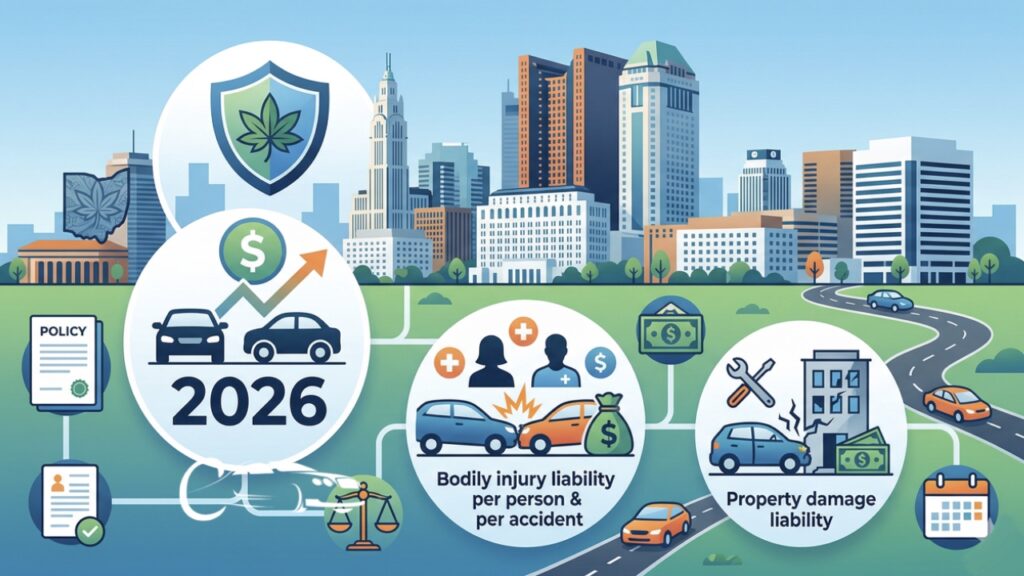
Ohio law requires all drivers to carry liability insurance that meets specific minimum coverage limits. These limits are often written in a shorthand format like 25/50/25, which represents three separate coverage components. Here is what each number means and what it covers.
Bodily Injury Liability Per Person
The first number, $25,000, is the minimum amount your insurance must cover for bodily injury to a single person in an accident where you are at fault. This covers medical expenses, rehabilitation costs, lost wages, and pain and suffering claims for one injured person.
If the person you injured has medical bills totaling $40,000, your insurance covers $25,000 and you are personally responsible for the remaining $15,000 unless you have higher coverage limits. This is one of the main reasons most insurance professionals recommend carrying more than the legal minimum.
Bodily Injury Liability Per Accident
The second number, $50,000, is the total your insurer will pay for bodily injuries across all people injured in a single accident where you are at fault. If three people are hurt in a collision you caused, your insurance will cover their combined medical costs up to $50,000 total, regardless of how those costs are divided between them.
This per-accident cap is especially important in multi-vehicle accidents or situations where multiple passengers are injured. Costs can escalate quickly, and the $50,000 limit can feel thin in serious accidents involving more than one injured party.
Property Damage Liability
The third number, $25,000, represents the minimum property damage liability coverage required in Ohio. This covers repairs or replacement of property damaged in an accident you caused. Most commonly, this means the other driver’s vehicle, but it can also include fences, buildings, guardrails, or any other property that gets damaged.
With the average cost of a new car now well above $40,000, a $25,000 property damage minimum can leave a gap if the vehicle you damage is a newer or more expensive model. Again, this is why many drivers choose to go above the state minimum.
What Ohio’s Minimum Insurance Does Not Cover
This is one of the most important things to understand. Ohio’s minimum liability requirements only cover damages to other people and their property when you are at fault. They do not cover you or your vehicle in any scenario.
Here is what is not included under Ohio’s minimum insurance requirements:
Collision Coverage is not required by law. If you crash into another car or a stationary object, any damage to your own vehicle will not be covered unless you have purchased collision coverage separately.
Comprehensive Coverage is also not legally required. This covers non-collision damage to your vehicle like theft, vandalism, hail, flooding, and animal strikes.
Medical Payments Coverage is optional in Ohio. While bodily injury liability covers injuries to others you harm, it does not pay your own medical bills after an accident.
Uninsured and Underinsured Motorist Coverage is another optional add-on in Ohio. Given that a significant portion of drivers nationwide drive without adequate insurance, this coverage protects you when the at-fault driver cannot fully pay for your damages.
Gap Insurance is worth mentioning here as well. If you financed or leased your vehicle, your lender almost certainly requires full coverage (collision and comprehensive) in addition to liability. Gap insurance specifically covers the difference between what you owe on your car and what it is currently worth if it gets totaled.
How Ohio Verifies Insurance Coverage
Ohio uses an electronic insurance verification system. Insurance companies are required to electronically report policy information to the Ohio Bureau of Motor Vehicles (BMV). This means the state can verify whether your vehicle is insured at the time of registration renewal and during traffic stops.
Law enforcement officers can check your insurance status in real time during a stop. You are also required to show proof of insurance upon request. Most drivers carry a physical insurance card, but digital proof on a smartphone is also accepted in Ohio.
If the BMV determines your vehicle is uninsured, you can expect a letter notifying you that your registration and license plates are subject to suspension. Acting quickly when you receive that kind of notice is important because the penalties compound if you ignore them.
Penalties for Driving Without Insurance in Ohio
Ohio takes uninsured driving seriously. The consequences are layered and can get expensive fast.
For a first offense, you can face a fine between $160 and $500. Your driver’s license, vehicle registration, and license plates will be suspended. To reinstate them, you will need to pay a reinstatement fee and provide proof of insurance.
For repeat offenses, the fines increase and the suspension periods lengthen. A second offense within five years can result in a longer suspension and a higher reinstatement fee. Depending on the circumstances, some situations can escalate to criminal misdemeanor charges.
Beyond the immediate penalties, an insurance lapse on your record can drive up your premiums significantly when you do get coverage again. Insurers view a history of gaps in coverage as a risk factor, and they price their policies accordingly.
Should You Carry More Than the Minimum?
The honest answer is yes, in most cases. Ohio’s minimum insurance requirements set a floor, not a ceiling. They represent the bare legal minimum, not the recommended level of protection for most drivers.
Consider what the numbers actually look like in a real accident. If you cause a crash that sends two people to the hospital with serious injuries, medical costs can easily reach $100,000 or more. Your $50,000 per-accident limit covers half of that, and you are personally on the hook for the rest. If you own a home, have savings, or earn an income, that kind of judgment can seriously disrupt your financial life.
Many insurance agents and financial planners recommend coverage limits of at least 100/300/100 for most drivers. This means $100,000 per person, $300,000 per accident, and $100,000 in property damage. For drivers with significant assets, an umbrella policy on top of that provides an additional layer of protection.
Adding uninsured motorist coverage is also worth considering. Ohio has a notable percentage of drivers who are either completely uninsured or carry only the bare minimum. If one of them causes an accident that injures you, your bodily injury liability coverage does not help you. Uninsured and underinsured motorist coverage fills that gap.
Special Situations That Affect Insurance Requirements in Ohio
Financed and Leased Vehicles
If your car is financed through a bank or credit union, or if you are leasing it, your lender or leasing company will almost certainly require full coverage, which includes comprehensive and collision on top of the state minimum liability requirements. This is contractual and not optional. Dropping to liability-only while still making car payments puts you in violation of your loan or lease agreement and can result in the lender placing forced insurance on your vehicle at a much higher cost.
Teen Drivers
Adding a teen driver to your policy dramatically affects your premiums. Teen drivers statistically have higher accident rates, and insurers price accordingly. Given their elevated risk profile, carrying more than the minimum is especially wise when a young driver is on the policy.
High-Value Vehicles
If you drive an expensive car, the minimum $25,000 property damage limit is almost certainly not enough to cover your own vehicle, let alone someone else’s. Comprehensive and collision coverage become very important in this context.
Rideshare Drivers
If you drive for Uber, Lyft, or a similar rideshare platform in Ohio, your personal auto policy typically does not cover you while you are logged into the app and waiting for a ride request. Most rideshare companies provide some coverage during active trips, but the gaps in between can leave you exposed. Rideshare endorsements are available through many insurers to fill this gap.
How to Find Affordable Car Insurance in Ohio That Meets Minimum Requirements
Meeting Ohio’s minimum requirements does not have to be expensive. Ohio is actually one of the more affordable states for car insurance on average. That said, your individual rate will depend on a variety of factors including your driving history, age, credit score, vehicle type, and location within the state.
Here are a few practical ways to keep costs manageable while staying compliant:
Comparing quotes from multiple insurers is the single most effective way to find a better rate. Prices for the same coverage can vary by hundreds of dollars per year between companies.
Bundling your car insurance with a renters or homeowners policy often earns a meaningful discount with most major insurers.
Maintaining a clean driving record is the most consistent way to keep your premium low over time. Accidents and violations can significantly raise your rates for several years.
Asking about discounts is worth doing every time you review your policy. Many insurers offer discounts for safe driving programs, low annual mileage, paying your premium in full, and even good grades for student drivers.
Raising your deductible on collision and comprehensive coverage (if you carry them) can lower your monthly premium, though it means more out-of-pocket cost if you do make a claim.
Ohio SR-22 Requirements
An SR-22 is not insurance itself. It is a certificate of financial responsibility that Ohio requires certain drivers to file with the BMV to prove they are carrying at least the state minimum insurance. You may be required to obtain an SR-22 if your license was suspended for driving uninsured, you were convicted of a serious traffic violation, or you were involved in an accident while uninsured.
Your insurance company files the SR-22 on your behalf, but not all insurers offer SR-22 filings. If yours does not, you may need to switch to a provider that does. Having an SR-22 on your record typically increases your insurance premiums because it signals higher risk to insurers. Most SR-22 requirements in Ohio last for three years, after which you can return to standard coverage if your record is clean.
Final Thoughts on Ohio Car Insurance in 2026
Staying insured is one of the most basic responsibilities that comes with driving in Ohio. The state’s minimum requirements in 2026 remain at 25/50/25, which covers bodily injury and property damage liability for situations where you cause an accident. These minimums are a legal baseline, and for many drivers they represent the least amount of coverage that makes practical sense.
Understanding what these numbers mean in real-world terms helps you make better decisions. The gap between what minimum insurance covers and what an actual serious accident costs can be substantial. Carrying more coverage than the law requires is not about spending more money. It is about protecting your income, your assets, and your peace of mind in situations where things go badly wrong on the road.
Take the time to review your current policy, know exactly what you are covered for, and make adjustments if your coverage no longer reflects your actual risk or your financial situation. Staying covered and staying smart about what that coverage actually does are two different things, and both matter.