
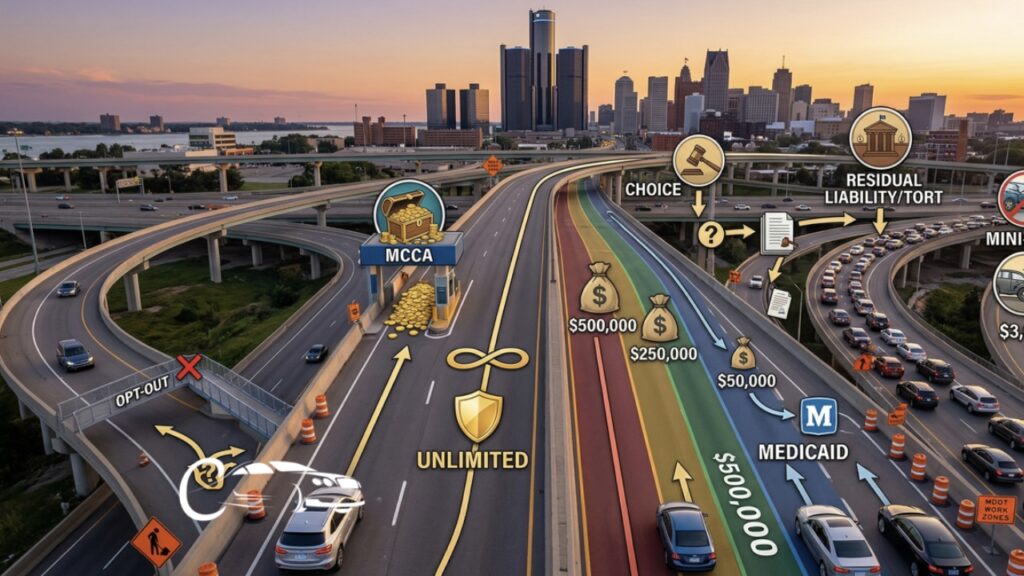
If you’re a driver in Michigan, you’re already operating under the most legally intricate auto insurance framework in the United States. This isn’t hyperbole — it’s a structural reality that has shaped court decisions, bankrupted families, and driven more legislative debate than any other single insurance issue in American state history. Michigan’s no-fault system isn’t just different from other states. It operates on a fundamentally different logic, with layered coverage requirements, tiered PIP elections, and legal thresholds that most drivers never fully understand until something goes wrong.
This guide is the definitive breakdown of Michigan’s auto insurance laws for 2026 — what you’re required to carry, what each coverage does, what it costs, and where most Michigan drivers are leaving themselves exposed without realizing it.
Is Car Insurance Required in Michigan?
Yes — and Michigan’s requirement goes further than most states imagine.
Under Michigan’s No-Fault Insurance Act (MCL 500.3101), every owner or registrant of a motor vehicle required to be registered in the state must maintain a no-fault insurance policy. Unlike many states that simply require liability coverage, Michigan mandates a specific multi-layered policy structure that includes personal injury protection, property protection insurance, and residual liability coverage.
What makes Michigan’s mandate structurally unique is that it applies regardless of fault in an accident. Michigan operates as a pure no-fault state, which means your own insurance — not the other driver’s — pays for your medical expenses and lost wages after a crash, regardless of who caused it. This fundamentally changes both the purpose and the cost of the coverage you’re required to carry.
The requirement is enforced continuously. Michigan law does not require you to maintain insurance only when driving. If your vehicle is registered in the state, coverage must remain in force.
Michigan’s Minimum Auto Insurance Requirements in 2026
Michigan’s mandatory policy structure is built around three core components, each serving a distinct function. Understanding all three — and how they interact — is essential to making informed coverage decisions.
1. Personal Injury Protection (PIP) — Tiered Coverage Levels
PIP is the foundation of Michigan’s no-fault system and the most consequential decision every Michigan driver makes when purchasing insurance. Since the landmark 2020 reform (Public Acts 21 and 22 of 2019), Michigan drivers are no longer required to carry unlimited lifetime PIP coverage. Instead, they must choose from a tiered menu of options:
PIP Coverage Tiers (as of 2026):
| PIP Tier | Coverage Limit | Who Can Select This |
| Unlimited | No cap on medical benefits | Any Michigan driver |
| $500,000 per person | Capped at $500,000 | Any Michigan driver |
| $250,000 per person | Capped at $250,000 | Any Michigan driver |
| $50,000 per person | Capped at $50,000 | Drivers enrolled in Medicaid only |
| PIP Opt-Out | No PIP coverage | Medicare-eligible drivers only |
This is where the complexity begins. Before 2020, every Michigan driver had the same PIP tier: unlimited, for life. That was the law for nearly 50 years. The 2020 reform changed everything, requiring every driver to affirmatively choose a level of medical coverage — a decision that carries life-altering financial consequences if made incorrectly.
What PIP Actually Covers:
PIP pays for medical expenses, rehabilitative care, attendant care (in-home nursing services), a percentage of lost wages, and replacement services (help with household tasks you can no longer perform). Under Michigan law, PIP benefits kick in immediately after an accident — there’s no waiting for fault to be determined, no fighting with another driver’s insurer, no coverage gap while the claim is processed. This is the practical benefit of no-fault: speed and certainty of payment.
However, the right PIP tier for you depends on your existing health coverage. A driver with robust employer-sponsored health insurance that explicitly covers auto accidents may find the $250,000 tier adequate. A driver without comprehensive health coverage — or one who is self-employed — has far more to lose by selecting lower PIP limits. The premium savings from downgrading PIP apply only to approximately 45% of your total policy cost, meaning the dollar savings are often smaller than drivers expect.
The Qualified Health Coverage Rule:
Michigan law allows certain drivers to select reduced PIP limits — or opt out entirely — only if they have Qualified Health Coverage (QHC). For the period July 1, 2025 through June 30, 2026, the maximum allowable deductible for health insurance to qualify as QHC is $6,579. If your health plan’s deductible exceeds this threshold, you do not qualify for reduced PIP, regardless of your other health coverage terms.
This is a detail that catches thousands of Michigan drivers off guard every year.
2. Property Protection Insurance (PPI) — $1,000,000 Mandatory
Michigan requires every vehicle owner to carry Property Protection Insurance with a mandatory limit of $1,000,000. This is not a typo, and it’s not optional.
PPI covers damage your vehicle causes to other people’s tangible property within the state of Michigan — parked cars, buildings, fences, utility poles, lawns, trees, and other fixed structures. It does not cover damage to other moving vehicles (that’s handled separately under residual liability), and it does not cover property damage that occurs outside Michigan’s borders.
The $1 million mandatory limit reflects the state’s recognition that vehicle-caused property damage — particularly in commercial or urban settings — can generate enormous claims. A vehicle that loses control and strikes a building, a commercial storefront, or a row of parked vehicles can easily generate six-figure damage. Michigan’s PPI requirement ensures that victims of such incidents don’t face an insurance gap.
This coverage is embedded in every Michigan no-fault policy by law. You don’t elect it, and you can’t waive it.
3. Residual Bodily Injury and Property Damage Liability (BI/PD)
Here’s where Michigan’s system diverges most sharply from the liability-centric frameworks most other states use.
In a standard at-fault state, bodily injury liability is the primary mechanism through which accident victims get compensated. The at-fault driver’s liability insurance pays the injured party’s medical bills. Michigan’s no-fault system short-circuits most of that pathway — each driver’s own PIP covers their own medical costs regardless of fault. But residual liability in Michigan still matters, and it matters a great deal in serious accident scenarios.
Residual BI/PD covers two specific situations:
First, it applies when a Michigan driver causes an accident with injuries serious enough to meet the state’s “serious injury threshold” — which includes death, permanent serious disfigurement, and serious impairment of a body function. When those thresholds are met, the injured party can step outside the no-fault system and sue the at-fault driver for pain and suffering, excess economic damages, and other non-economic losses. Your residual BI coverage pays your defense and any judgment up to your policy limits.
Second, residual property damage (PD) covers damage your vehicle causes to other vehicles or property outside of Michigan. Within Michigan, PPI handles property damage. The moment you cross a state line, PD becomes operative.
Michigan’s Bodily Injury Limits — Default vs. Minimum:
| Limit Type | Per Person | Per Accident |
| Default Limits | $250,000 | $500,000 |
| Minimum Allowable | $50,000 | $100,000 |
| Out-of-State Property Damage | — | $10,000 |
This is a critical nuance: Michigan’s default bodily injury limits — the ones you’ll be quoted automatically unless you affirmatively request otherwise — are $250,000/$500,000. The minimums you can legally elect are $50,000/$100,000. Most other states structure this in reverse, presenting minimum coverage and allowing upgrades. Michigan’s structure assumes higher coverage unless you actively choose lower limits.
Michigan’s Complete Auto Insurance Requirements at a Glance
| Coverage Type | Minimum / Default | What It Covers |
| PIP (Personal Injury Protection) | $50,000–Unlimited (tiered) | Your medical bills, lost wages, attendant care |
| PPI (Property Protection Insurance) | $1,000,000 (mandatory) | Damage to others’ property in Michigan |
| Bodily Injury Liability (per person) | $50,000 min / $250,000 default | Serious injury lawsuits against you |
| Bodily Injury Liability (per accident) | $100,000 min / $500,000 default | Total judgment exposure per accident |
| Out-of-State Property Damage | $10,000 | Property damage you cause outside Michigan |
The Mini-Tort Law: Michigan’s Unique Vehicle Damage Rule
One of the most misunderstood aspects of Michigan’s system is how it handles damage to your own vehicle after an accident you didn’t cause.
In most states, if someone rear-ends you and you’re clearly not at fault, you file a claim against their liability insurance to repair your car. Michigan’s no-fault system doesn’t work that way. Collision damage to your vehicle in an at-fault accident is not covered under the no-fault framework — it’s only covered if you’ve separately purchased collision coverage.
The mini-tort provision partially addresses this. Michigan law allows you to recover up to $3,000 (increased from $1,000 under the 2020 reform) from an at-fault driver for vehicle damage not covered by your own collision insurance. This applies when the other driver was more than 50% at fault and you either don’t carry collision coverage or have a deductible that exceeds the repair cost.
Three thousand dollars is a maximum, not a guarantee. If your deductible is $500 and your repair costs $4,800, you can recover up to $3,000 via mini-tort — but you still bear $1,300 of that cost yourself.
This structure is why Michigan insurance professionals consistently emphasize purchasing collision coverage, even when it’s not legally required.
What Does Car Insurance Cost in Michigan in 2026?
Michigan’s structural complexity has a direct and significant impact on what drivers pay. The state consistently ranks among the most expensive in the nation for auto insurance, and the data for 2026 reflects that reality clearly.
<br>
Statewide Average Premiums (2026):
| Coverage Level | Monthly Estimate | Annual Estimate | Source |
| Minimum coverage | $64–$135 | $768–$1,615 | MoneyGeek / Insurify |
| Full coverage | $138–$237 | $1,656–$2,844 | MoneyGeek / Experian |
| Bankrate annual average (full) | $267/mo | $3,207/year | Bankrate |
| The Zebra annual average | — | $2,610/year | The Zebra |
The wide range in these figures reflects the genuine variability of Michigan’s pricing landscape. Methodology differences, driver profiles, and geographic focus all contribute to the spread. But the consistent takeaway is clear: Michigan drivers pay substantially above the national average across all coverage tiers.
The Detroit Premium — A City of Its Own:
Detroit consistently ranks as one of the most expensive cities for auto insurance anywhere in the United States. The data is striking:
- Detroit full coverage average: $289–$363/month (MoneyGeek / various sources)
- State average full coverage: $138–$211/month
- Detroit’s premium above state average: 109% or more
Detroit’s elevated rates reflect the intersection of high traffic density, elevated vehicle theft rates (up 56% statewide between 2019 and 2023, per Michigan State Police), above-average accident frequency, high medical costs, and a litigation environment that pushes claims costs higher. Surrounding communities like Dearborn and Hamtramck also face significantly elevated premiums relative to western Michigan cities like Kalamazoo or Ann Arbor.
Cheapest Insurers in Michigan for 2026:
| Company | Est. Monthly (Min. Coverage) | Est. Monthly (Full Coverage) |
| GEICO | $70–$80 | $70 |
| Travelers | $61–$79 | $79 |
| Auto-Owners | $68–$90 | Varies |
| USAA (military only) | $60–$75 | Competitive |
| Progressive | $72–$107 | $107 |
| State Farm | $85–$120 | Varies |
Rate estimates drawn from MoneyGeek, Insurify, Bankrate, and U.S. News data (2026). Your actual premium depends on your ZIP code, driving record, PIP tier selection, age, and vehicle.
What Michigan Uniquely Prohibits Insurers from Using:
Michigan law prohibits auto insurers from using ZIP code, credit score, gender, or marital status as rating factors. This makes Michigan’s pricing framework fundamentally different from most other states, where credit score alone can shift premiums by hundreds of dollars annually. In Michigan, your driving record, age, vehicle type, and PIP tier selection are the primary rating variables.
What Happens If You Drive Without Insurance in Michigan?
Michigan’s uninsured driver problem is substantial — approximately 20% of Michigan drivers are uninsured, compared to a national average of roughly 13%. This rate was as high as 26% in 2019 before the 2020 reform lowered PIP costs and made coverage more accessible. The practical consequences for those caught without coverage are serious.
Legal and financial penalties for driving uninsured in Michigan:
- Civil infraction fines up to $500
- License suspension
- Vehicle registration suspension
- Potential criminal charges for repeat offenders
- Personal liability for all accident-related damages — medical, property, and legal judgments — with no insurer to backstop you
The uninsured penalty that matters most, however, isn’t the fine — it’s the financial exposure in an accident. An uninsured Michigan driver involved in a serious crash faces the full weight of the injured party’s medical bills, wage losses, and pain and suffering claims without any coverage to absorb them. Given Michigan’s default BI/PD limits of $250,000/$500,000, a single serious accident can produce a judgment that exceeds most households’ entire net worth.
The Michigan Automobile Insurance Placement Facility (MAIPF) exists as a last-resort option for high-risk drivers who cannot obtain coverage in the standard market. It’s expensive — but it ensures that no Michigan driver is permanently locked out of the coverage they’re legally required to carry.
Why Michigan’s Minimum Coverage Is Often Insufficient
Michigan’s minimum legal requirements represent the floor — not an adequate level of financial protection. The gap between minimum coverage and real-world exposure is significant enough that most experienced insurance professionals will never write a minimum-coverage-only policy without explicitly discussing the risks with their client.
The PIP Exposure Problem:
A driver who selects the $50,000 PIP tier without Medicaid enrollment is likely not eligible for that tier to begin with. But even a driver on the $250,000 tier who suffers a traumatic brain injury, spinal damage, or requires long-term rehabilitation can exhaust that coverage within a year or two of serious care. Lifetime care for catastrophic injuries can cost $3 million to $10 million or more. The unlimited PIP tier exists precisely because these scenarios are not hypothetical — they happen on Michigan roads every week.
The Liability Exposure Problem:
A driver who elects the minimum BI limit of $50,000/$100,000 is protected against judgments up to those amounts. But a wrongful death case in Michigan — or a serious impairment case involving a young, high-earning plaintiff — can produce verdicts in the millions. An attorney-level recommendation in Michigan for bodily injury limits is $500,000/$1,000,000 or higher. The annual premium difference between minimum BI and $500,000/$1,000,000 is often less than $150 per year.
The Vehicle Damage Gap:
Michigan’s no-fault system does not automatically cover damage to your own vehicle when you’re at fault. Without collision coverage, you bear the full repair or replacement cost out of pocket. The mini-tort maximum of $3,000 from an at-fault third party does not come close to covering a totaled late-model vehicle. For any driver with a vehicle worth more than $5,000 — which describes virtually every car on Michigan roads today — collision coverage is financially prudent regardless of whether a lender requires it.
Michigan’s 2020 No-Fault Reform: What Changed and Why It Matters in 2026
The 2019 legislative overhaul — which took effect July 1, 2020 — was the most significant restructuring of Michigan’s auto insurance system in nearly five decades. Understanding what changed is essential context for every coverage decision Michigan drivers make today.
The Five Core Changes:
1. PIP Choice: The shift from mandatory unlimited PIP to tiered options. This was the headline change — and the one with the most far-reaching individual consequences.
2. Medicare Opt-Out: Medicare-eligible drivers gained the ability to opt out of PIP entirely, eliminating a coverage cost for those who have Medicare as their primary coverage.
3. Medical Fee Schedule: Michigan implemented a fee schedule for no-fault medical billing, capping what providers can charge no-fault insurers at a percentage of Medicare rates. This was intended to reduce fraud and control medical costs within the no-fault system.
4. Attendant Care Limits: The reform capped the hours per day that a family member can be compensated for providing attendant care to an injured relative under a no-fault policy — a significant change for families providing in-home nursing.
5. Increased BI Minimums and Default Limits: The reform raised the default BI/PD limits from $20,000/$40,000 to the current $250,000/$500,000, while also allowing drivers to elect the reduced $50,000/$100,000 minimum if they choose.
The Results Six Years In:
The reform succeeded in its primary objective of reducing premiums for many drivers. The uninsured rate dropped from 26% in 2019 to approximately 20% by the mid-2020s, reflecting improved affordability. However, critics — particularly plaintiff attorneys and disability advocacy groups — argue that the PIP tier system and the medical fee schedule have reduced access to care for seriously injured accident victims and shifted financial exposure onto individual families who made coverage decisions without fully understanding their implications.
For drivers in 2026, the takeaway is this: the choices you make when purchasing Michigan auto insurance matter more than they do in any other state. The tiered PIP system means two otherwise identical drivers can have vastly different financial outcomes after the same accident, depending solely on the PIP tier each selected when they bought their policy.
Uninsured and Underinsured Motorist Coverage in Michigan
Unlike New York, Michigan does not mandate uninsured motorist (UM) coverage. It is offered — and must be offered by law — but is not compulsory. Given that approximately one in five Michigan drivers is uninsured, this is a gap that deserves serious attention.
If an uninsured driver strikes you and causes injuries that exhaust or exceed your PIP benefits, UM coverage becomes the financial backstop that determines whether those remaining costs are covered or left to you personally. Underinsured motorist coverage (UIM) provides a similar function when the at-fault driver carries coverage, but not enough to satisfy the full extent of the damages they caused.
Experienced Michigan insurance professionals consistently recommend purchasing UM/UIM coverage at limits that match your bodily injury liability limits — at minimum, $250,000/$500,000. The additional premium is modest relative to the exposure it covers.
Proof of Insurance Requirements in Michigan
Michigan drivers must carry proof of insurance in their vehicle at all times and must produce it upon request from law enforcement. Michigan accepts both physical insurance ID cards and electronic proof of insurance displayed on a mobile device.
When law enforcement runs your plates, they can access your insurance status through the state’s data systems. Insurers are required to report policy issuance and termination to the state. A lapsed or cancelled policy generates a record that can trigger enforcement action, particularly if you’re stopped for any other reason while uninsured.
Your insurance documentation must match your vehicle registration. A name mismatch — even a minor formatting discrepancy — can create administrative complications.
The Bottom Line on Michigan Auto Insurance in 2026
Michigan’s auto insurance system is not designed to be simple. It is designed to be comprehensive — to ensure that injured accident victims receive immediate medical care, that property damage victims are made whole, and that fault determinations don’t delay the process of recovery. That design comes with complexity, and that complexity comes with cost.
The state average for full coverage in Michigan runs 82% above the national average, according to The Zebra’s analysis. Detroit-area drivers pay even more. These costs are the price of a system that guarantees certain outcomes — but only if you select the right coverage tiers.
The most important decisions Michigan drivers face aren’t about finding the cheapest policy. They’re about selecting a PIP tier that reflects their actual health coverage situation, choosing BI limits that protect their financial assets from judgment exposure, and adding optional coverages — collision, UM/UIM — that fill the significant gaps Michigan’s mandatory framework leaves open.
A minimum-coverage Michigan policy gets you legal compliance. It doesn’t get you financial protection. Those are two very different things, and understanding the difference is the essential first step for every driver navigating one of the most complex auto insurance environments in the country.
All rate data sourced from Bankrate, MoneyGeek, Insurify, Experian, The Zebra, and U.S. News (2026). Coverage requirements sourced from Michigan Compiled Laws (MCL 500.3101 et seq.) and the Michigan Department of Insurance and Financial Services (DIFS). Rates are estimates and will vary based on individual driver profile, ZIP code, and insurer.