
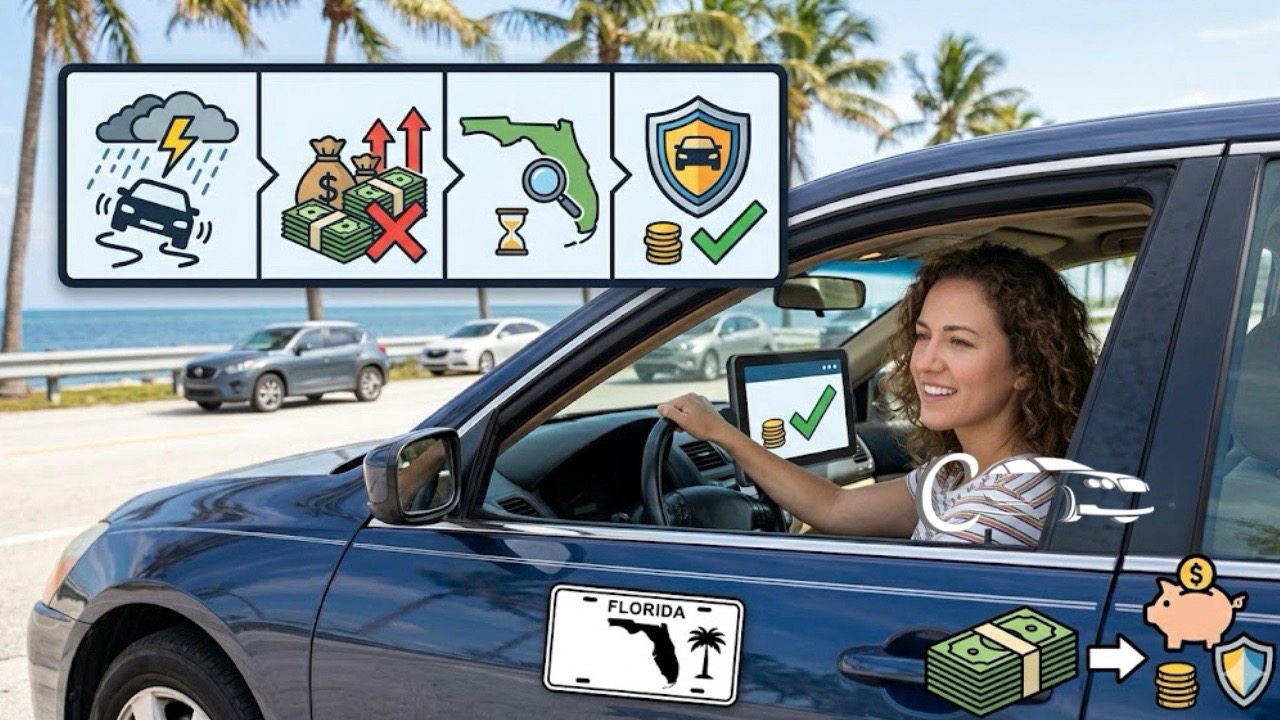
If you’ve been labeled a high-risk driver by an insurance company, you already know the sting of it — rates that seem punitive, insurers that turn you away outright, and a sense that getting back on track financially is an uphill battle. But here’s the thing: being high-risk in Florida doesn’t mean you’re stuck paying sky-high premiums forever. It means you need to be smarter about where you look, what you ask for, and how you build your case for a lower rate.
This guide cuts through the noise. We’ve analyzed insurer pricing behavior, studied Florida’s specific regulatory environment, and compiled everything a high-risk driver needs to find the cheapest possible car insurance in the Sunshine State — without sacrificing the coverage that protects you legally and financially.
Who Qualifies as a High-Risk Driver in Florida?
Insurance companies don’t publish a universal definition of “high-risk,” but the category generally includes anyone whose driving history, personal profile, or vehicle choice signals a higher-than-average likelihood of filing a claim. In Florida, insurers factor in the following:
- A DUI or DWI conviction within the past 3 to 10 years (varies by insurer)
- Multiple at-fault accidents within a 3-year window
- Serious moving violations such as reckless driving, excessive speeding (25+ mph over the limit), or street racing
- A lapse in coverage — even a short gap can trigger higher rates
- Filing multiple claims in a short period, regardless of fault
- Being a newly licensed driver under 25, especially males
- Poor credit history — Florida is one of the states that allows credit-based insurance scoring
- SR-22 requirement (more on this below)
It’s worth noting that Florida’s insurance market is already one of the most expensive in the country. According to data tracked by major insurance research organizations, Florida consistently ranks in the top five most expensive states for auto insurance. That baseline makes being high-risk especially costly — which is why knowing how to shop matters more here than almost anywhere else.
Understanding SR-22 in Florida: What It Is and What It Costs
An SR-22 is not insurance — it’s a certificate of financial responsibility that your insurer files with the Florida Department of Highway Safety and Motor Vehicles (FLHSMV) on your behalf. It proves you carry the state’s minimum required coverage. You’ll need one if:
- You were convicted of a DUI or DWI
- Your license was suspended for driving uninsured
- You were involved in an at-fault accident without insurance
- You accumulated too many points on your license
Florida typically requires SR-22 filing for three years, though the clock resets if you let coverage lapse during that period. The SR-22 filing itself usually costs between $15 and $50 as a one-time administrative fee, but the real cost is the insurance premium attached to it — which can be 50% to 100% higher than standard rates.
| Important: FR-44 vs. SR-22 in Florida: Florida uses FR-44 certificates specifically for DUI/DWI convictions — not the standard SR-22. An FR-44 requires you to carry double the state’s minimum liability limits ($20,000/$40,000 bodily injury and $20,000 property damage), which means it costs significantly more than a standard SR-22 requirement. If you have a DUI on your record, ask insurers specifically about FR-44 filing and pricing. |
Florida’s Minimum Insurance Requirements for High-Risk Drivers
Before diving into pricing, let’s be clear on what you’re legally required to carry. Florida operates under a no-fault system, which means every driver must maintain:
- Personal Injury Protection (PIP): $10,000 minimum — covers 80% of your medical expenses and 60% of lost wages regardless of fault
- Property Damage Liability (PDL): $10,000 minimum — covers damage you cause to someone else’s property
Note that Florida does not require bodily injury liability (BI) as a standard minimum — though this is expected to change when Senate Bill 1256 (proposing BI minimums of $25,000/$50,000) potentially takes effect. High-risk drivers, particularly those under FR-44 requirements, must carry higher limits. Even if you’re not legally required to carry more, consider adding uninsured motorist (UM) coverage — Florida has one of the highest rates of uninsured drivers in the country, estimated at over 20% of all drivers on the road.
Average Cost of Car Insurance for High-Risk Drivers in Florida
Rates vary enormously based on the specific risk factor involved. Below is a representative breakdown of what high-risk Florida drivers typically pay for minimum coverage versus full coverage, compared to the state average for a clean-record driver:
| Risk Factor | Avg. Annual (Min. Coverage) | Avg. Annual (Full Coverage) | Increase vs. Clean Record |
| Clean record (baseline) | $1,050 – $1,300 | $2,400 – $2,900 | — |
| 1 at-fault accident | $1,500 – $1,900 | $3,200 – $4,000 | +40–55% |
| 2+ at-fault accidents | $2,000 – $2,600 | $4,200 – $5,500 | +70–110% |
| 1 speeding ticket (minor) | $1,200 – $1,550 | $2,700 – $3,400 | +15–25% |
| Reckless driving | $2,200 – $3,000 | $4,500 – $6,000 | +90–130% |
| DUI (FR-44 required) | $3,000 – $4,500 | $5,500 – $8,000+ | +150–200% |
| No prior insurance | $1,600 – $2,200 | $3,400 – $4,600 | +55–80% |
| Poor credit score (<580) | $1,900 – $2,700 | $4,000 – $5,800 | +80–120% |
These are estimates based on aggregated industry data. Your actual quote will depend on your ZIP code, the insurer, your age, and the combination of risk factors on your record — multiple compounding factors can push rates even higher.
The Cheapest Car Insurance Companies for High-Risk Drivers in Florida
Not all insurers treat high-risk drivers the same way. Some specialize in non-standard markets and can offer surprisingly competitive rates to drivers that mainstream carriers won’t touch at a reasonable price. Here’s what the market looks like:
1. State Farm
State Farm consistently offers some of the most competitive rates for drivers with a single at-fault accident or minor violation on their record. Their large risk pool allows them to absorb moderate risk at lower premiums than many competitors. They also offer a robust discount ecosystem — bundling, good student, defensive driving — that can partially offset rate increases. Not the go-to for DUI cases, but excellent for most other risk factors.
2. GEICO
GEICO’s pricing algorithm tends to be favorable for drivers with speeding tickets and minor violations. Their digital-first model keeps overhead low, which translates into competitive premiums even for non-standard risk profiles. GEICO is also one of the more accessible options for SR-22 filings in Florida. Worth getting a quote even if you assume you won’t qualify for a good rate.
3. Progressive
Progressive built its brand around high-risk drivers and remains one of the strongest options for DUI convictions, multiple accidents, and FR-44 filings. Their Snapshot telematics program also gives risky drivers a way to demonstrate safe behavior and earn discounts going forward. Rates are higher than GEICO or State Farm for clean drivers but often significantly lower than the competition for seriously impaired records.
4. Dairyland Insurance
Dairyland is a non-standard carrier that explicitly targets high-risk drivers. If mainstream insurers have turned you away or quoted rates that are simply unaffordable, Dairyland is a strong fallback. They handle SR-22 and FR-44 filings routinely and offer flexible payment plans to manage upfront costs. Their rates won’t win any awards, but they fill a gap that standard carriers often won’t.
5. The General
Like Dairyland, The General operates in the non-standard market and provides coverage when other options dry up. They’re particularly known for working with drivers who have had license suspensions or lengthy coverage gaps. Premiums are on the higher end, but their barrier to acceptance is lower than almost any other insurer in Florida.
6. Travelers
Travelers is an underrated option for high-risk drivers who have had a DUI or serious violation but have otherwise maintained a clean record before or after the incident. Their underwriting takes a more holistic view, which can result in better rates for drivers who’ve demonstrated a clear pattern of improvement.
7. Bristol West (a Nationwide company)
Bristol West specializes in insuring drivers who’ve been declined by standard carriers. Operating as a subsidiary of Nationwide, they bring financial stability along with non-standard market expertise. A solid choice for drivers with multiple violations or a recent DUI in Florida.
| Pro Tip: Always Get at Least 5 QuotesThe spread between the cheapest and most expensive quote for the same high-risk driver in Florida can be $1,500 to $3,000 per year — sometimes more. Use comparison tools like The Zebra, Insurify, or NerdWallet alongside direct insurer quotes. Never assume the first number you see is close to the best available. |
How Florida’s No-Fault System Affects High-Risk Driver Costs
Florida’s Personal Injury Protection (PIP) requirement adds a mandatory cost layer that doesn’t exist in tort states. Every driver — including high-risk ones — must carry $10,000 in PIP regardless of their record. This creates a floor on what you’ll pay that can’t be negotiated away.
The interaction between PIP and high-risk status is important to understand. Because PIP pays regardless of fault, insurers price it based on your likelihood of filing a claim — and high-risk drivers (especially those with prior claims) pay significantly more for PIP than clean-record drivers. In some cases, PIP can represent a disproportionately large share of a high-risk driver’s total premium.
One practical strategy: if you have strong private health insurance that covers accident-related injuries, you can sometimes work with your insurer to structure your PIP more efficiently. While you cannot drop PIP entirely under current Florida law, discussing your existing health coverage with your agent can help ensure you’re not over-buying on the PIP side while you work to manage costs elsewhere.
Strategies to Lower Your Premium as a High-Risk Florida Driver
The good news: being high-risk isn’t a permanent state, and there are concrete steps you can take — starting today — to bring your premiums down.
1. Take a Florida-Approved Defensive Driving Course
Completing a state-approved Basic Driver Improvement (BDI) course can remove points from your license and may qualify you for an insurance discount of 5–10%. Florida’s FLHSMV maintains a list of approved courses, and many can be completed online. This is one of the fastest, cheapest interventions available.
2. Wait Out the Lookback Period Strategically
Most Florida insurers look back three years for accidents and minor violations, and up to seven to ten years for DUIs. Your rate will drop at each anniversary of an incident’s removal from your active record. If you’re six months away from a three-year anniversary, it may be worth getting a re-quote rather than waiting for your annual renewal.
3. Opt Into Telematics / Usage-Based Insurance
Programs like Progressive’s Snapshot, Allstate’s Drivewise, and State Farm’s Drive Safe & Save track your actual driving behavior — speed, braking, time of day, mileage. For high-risk drivers who drive cautiously and infrequently, these programs can produce discounts of 10–30%. The caveat: if your driving habits are genuinely poor, the data could work against you with some carriers.
4. Raise Your Deductible on Collision and Comprehensive
Moving from a $500 deductible to a $1,000 or $1,500 deductible on your collision and comprehensive coverage can reduce those portions of your premium by 15–25%. This is a calculated risk — you’re betting that you won’t have a minor at-fault accident — but for high-risk drivers trying to bring premiums to a manageable level, it’s a meaningful lever.
5. Bundle Auto With Renters or Homeowners Insurance
Even high-risk drivers can typically access multi-policy discounts. If you rent your home or own a property, bundling with the same carrier as your auto policy can yield 5–15% off each policy. This works even with non-standard carriers like Progressive, who also offers renters and homeowners products.
6. Improve Your Credit Score
Florida insurers are permitted to use credit-based insurance scores when pricing policies. The impact is significant: drivers with poor credit (below 580) pay on average 80–120% more than those with excellent credit for comparable coverage. While credit improvement isn’t instant, paying down revolving debt, removing errors from your credit report, and avoiding new credit inquiries can improve your score meaningfully within 6–12 months — and that improvement will show up in your next insurance renewal.
7. Reduce Coverage on Older Vehicles
If your vehicle is worth less than $5,000 to $6,000, carrying collision and comprehensive coverage may not be economically rational. Dropping those coverages on an older car can cut your total premium significantly while still maintaining the legally required PIP and PDL. Run the math: if the combined annual cost of collision and comprehensive exceeds 10% of your vehicle’s actual cash value, dropping them is worth serious consideration.
8. Pay Your Premium in Full
Most insurers offer a 5–10% discount for paying the full policy term upfront rather than monthly. For high-risk drivers on already-elevated premiums, this can represent $150–$400 in annual savings. If cash flow is the constraint, consider a short-term personal loan at a lower interest rate to cover the upfront payment, then pay it off over the policy period.
The Impact of ZIP Code on High-Risk Rates in Florida
Location matters enormously in Florida auto insurance pricing. Miami-Dade, Broward, and Palm Beach counties consistently post the highest average premiums in the state — the combination of dense traffic, high accident frequency, above-average uninsured driver rates, and severe weather risk creates a challenging pricing environment. For high-risk drivers in South Florida, the compounding effect of a bad record on top of a high-cost ZIP code can produce premiums that are nearly double the state average.
| Florida Region | Avg. Annual Premium (Clean Record) | High-Risk Multiplier | Notes |
| Miami-Dade County | $2,800 – $3,500 | 1.8x – 2.5x | Highest in state; dense traffic, high uninsured rate |
| Broward County | $2,400 – $3,100 | 1.7x – 2.3x | Fort Lauderdale area; similar factors to Miami |
| Palm Beach County | $2,200 – $2,800 | 1.6x – 2.1x | Moderately high; improving in suburban areas |
| Orange County (Orlando) | $1,800 – $2,400 | 1.5x – 1.9x | Mid-range; tourist traffic increases claim frequency |
| Hillsborough (Tampa) | $1,900 – $2,500 | 1.5x – 2.0x | Urban core expensive; suburbs more competitive |
| Jacksonville (Duval) | $1,600 – $2,100 | 1.4x – 1.8x | More affordable; good competition among carriers |
| Rural / Panhandle areas | $1,200 – $1,700 | 1.3x – 1.7x | Lowest premiums; less competition for non-standard |
If you’re in a high-cost ZIP code and struggling with premium costs, note that moving even a few miles — from an urban core to a surrounding suburb — can produce meaningful savings without changing insurers.
Common Mistakes High-Risk Drivers Make (and How to Avoid Them)
Letting Coverage Lapse to Save Money
This is the single most counterproductive thing a high-risk driver can do. A coverage lapse — even for 30 days — signals to future insurers that you’re a bad risk, creates a gap in your SR-22 or FR-44 requirement (resetting the clock), and can result in a license suspension. If your current premium is unaffordable, call your insurer before the payment is due and ask about payment plans or coverage adjustments. Don’t simply let it lapse.
Assuming Non-Standard Carriers Are Always Cheapest
Dairyland, The General, and Bristol West are valuable last-resort options, but they’re not always the cheapest. Many high-risk drivers automatically assume mainstream carriers won’t compete for their business and never bother getting quotes from State Farm, GEICO, or Progressive. That’s a costly assumption. Always get quotes from both standard and non-standard markets before deciding.
Not Disclosing the Full Picture
When getting quotes, some drivers omit accidents or violations hoping the insurer won’t find them. They will — through your Motor Vehicle Report (MVR) and CLUE (Comprehensive Loss Underwriting Exchange) report. If the insurer discovers the omission, they can cancel your policy for misrepresentation, leaving you in a far worse position than if you’d been upfront from the start.
Ignoring the FR-44 Distinction
As noted earlier, DUI convictions in Florida require an FR-44 rather than an SR-22. Drivers who don’t understand this distinction sometimes purchase a policy with SR-22 filing only to discover it doesn’t satisfy their reinstatement requirement. Confirm with the FLHSMV exactly what type of certificate is required before purchasing coverage.
How Long Does High-Risk Status Last in Florida?
The timeline depends on the specific offense. Here’s a practical guide:
| Offense / Factor | Standard Lookback Period | When Rate Relief Typically Starts |
| Minor speeding ticket | 3 years | 3-year anniversary of violation |
| At-fault accident | 3 years | 3-year anniversary; some insurers at 5 years |
| Reckless driving | 5 years | 5-year anniversary; varies by insurer |
| DUI / DWI (FR-44) | 7–10 years | Significant relief at 5–7 years; full at 10 |
| Coverage lapse | 1–3 years | After 12 months of continuous coverage |
| Poor credit | Ongoing | Improves with credit score; no fixed period |
One actionable tactic: shop for new quotes every 12 months, even mid-policy if a major anniversary is approaching. Insurers won’t proactively lower your rate when an incident ages off your record — you have to go out and get new quotes to capture that savings.
What to Expect After a DUI in Florida: A Realistic Picture
DUI convictions deserve their own discussion because the insurance consequences are severe and long-lasting. Here’s the realistic trajectory for a Florida driver convicted of DUI:
- Immediate policy cancellation or non-renewal from your current insurer is common
- FR-44 filing required for 3 years from reinstatement of driving privileges
- FR-44 requires doubled liability minimums, which raises base premium costs
- Annual premiums commonly range from $3,000 to $8,000+ for the first few years
- Progressive, Dairyland, and Bristol West are typically the most accessible options
- Some improvement visible around year 3–5 as the conviction ages
- Full rate normalization typically takes 7–10 years
The financial impact of a DUI extends well beyond the fines and legal fees. Over a ten-year period, the excess insurance cost alone can easily exceed $15,000 to $25,000 above what a clean-record driver would have paid. This makes DUI one of the most expensive driving offenses in Florida, even for first-time offenders.
Frequently Asked Questions
Can I get car insurance in Florida with a suspended license?
Yes — some non-standard insurers will write policies for drivers with suspended licenses, particularly if the suspension was due to a lapse in insurance rather than a criminal offense. You’ll typically need to carry SR-22 or FR-44 filing as part of your reinstatement requirements. Dairyland, The General, and Bristol West are among the carriers most willing to work with this situation.
Will my rates ever go back to normal after a DUI?
Yes, eventually — but patience is required. Most drivers see meaningful rate reductions at the 5-year mark, and the majority of insurers will treat you comparably to a clean-record driver by year 10. Maintaining a spotless record throughout that period, completing any required DUI programs, and actively shopping for new quotes every 12 months are the best ways to accelerate the process.
Does Florida’s no-fault system make high-risk insurance cheaper or more expensive?
PIP adds a mandatory cost that can’t be avoided, which makes Florida’s baseline more expensive for everyone. For high-risk drivers, the PIP component is priced based on claim likelihood — so it tends to be higher for those with prior accidents or violations. The no-fault system doesn’t inherently make high-risk insurance cheaper; it simply structures the mandatory cost differently.
Can I be denied car insurance entirely in Florida?
Standard market insurers can decline to write your policy, but Florida’s non-standard market — including The General, Dairyland, and Bristol West — exists precisely to serve drivers who’ve been declined elsewhere. In a worst-case scenario, Florida also has the Florida Automobile Joint Underwriting Association (FAJUA), a state-assigned risk pool that provides coverage of last resort for drivers who cannot obtain coverage in the private market.
How often should I re-shop my insurance as a high-risk driver?
At minimum, annually at renewal. But high-risk drivers should also check around 30 to 60 days before a major anniversary (e.g., the 3-year anniversary of an at-fault accident) because that’s when your rate profile changes and you may qualify for significantly better pricing. Set a calendar reminder.
The Bottom Line
Being a high-risk driver in Florida is expensive — there’s no way around that reality. But expensive doesn’t have to mean unmanageable, and it certainly doesn’t mean you’re stuck at your current rate forever. The drivers who pay the least despite their record are the ones who shop aggressively, understand which levers actually move the needle (telematics, credit improvement, anniversary timing), and refuse to accept the first quote they receive.
Work through the strategies in this guide systematically. Get quotes from both standard and non-standard carriers. Set anniversary reminders. Enroll in a defensive driving course this week. None of these things will fix your record overnight, but each one chips away at the premium you’re paying — and over the course of a few years, the cumulative savings are substantial.
For a deeper dive into how Florida’s PIP coverage works and what it actually pays for, read our companion article: PIP Insurance Florida: Cost and Coverage Explained (2026).
Disclaimer: Premium estimates in this article are derived from aggregated industry data and are for informational purposes only. Actual quotes will vary based on your specific driving record, location, vehicle, and the insurer’s current underwriting guidelines. Always obtain personalized quotes from licensed insurance providers.