
Introduction: The Insurance Gap Nobody Talks About
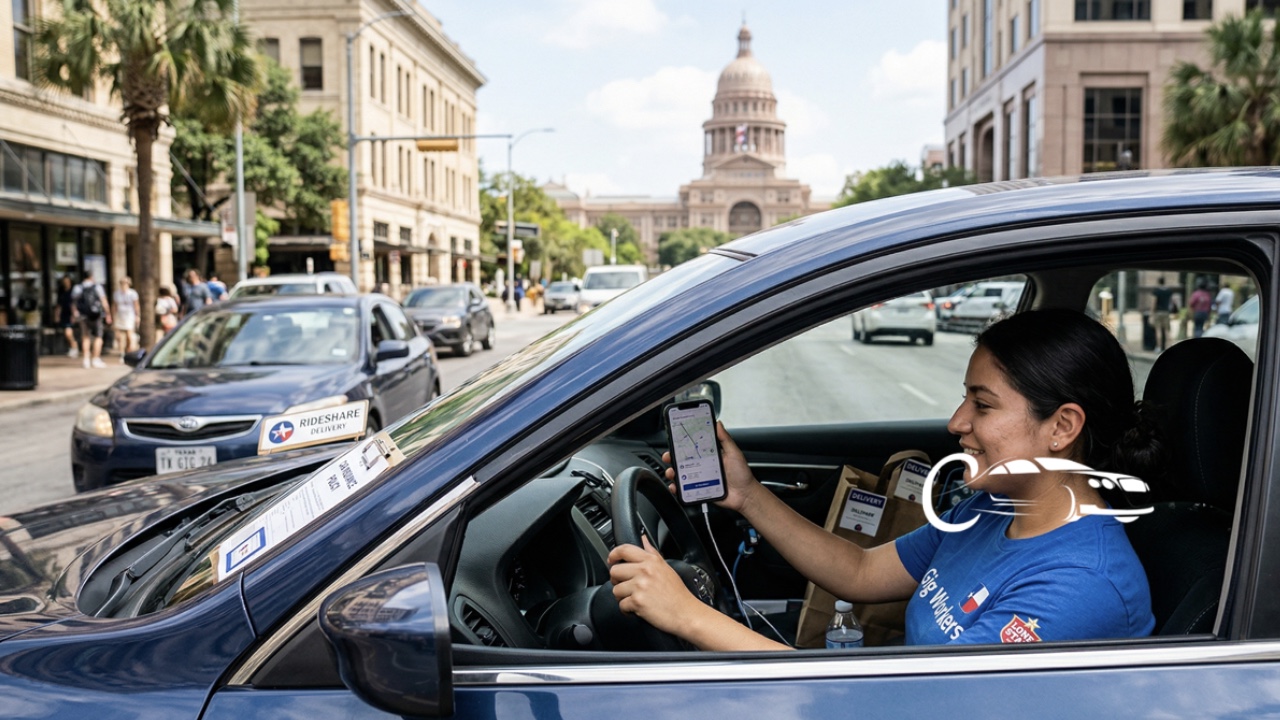
You’re up at 6 a.m., coffee in hand, logging into Door Dash or pulling up the Uber driver app. You’ve got a full tank, a clean car, and a to-do list that looks a lot like a regular workday because for millions of Texans, it is a regular workday.
The gig economy has changed the way people work, earn, and live. Today, over 70 million Americans — roughly 36% of the entire workforce — identify as gig workers, contributing over $1.27 trillion to the U.S. economy. In Texas alone, with its sprawling metro areas, massive suburban sprawl, and culture of independent hustle, the number of rideshare and delivery drivers is staggering.
But here’s the part most people gloss over: the moment you turn on that app and start driving for money, your regular car insurance may quietly stop protecting you. Not because you did anything wrong. Not because your policy was bad. But because the rules change when your car becomes a tool for earning income, and most personal auto policies aren’t written to cover that.
This guide is here to change that. Whether you drive for Uber, Lyft, DoorDash, Instacart, Amazon Flex, or some combination of all five, this article will walk you through exactly what insurance you need, what it costs, which companies offer the best coverage in Texas, and how to protect yourself without emptying your wallet.
Understanding Why Standard Car Insurance Isn’t Enough
Before we get into company recommendations and pricing, it helps to understand why standard car insurance falls short for gig workers because the answer isn’t obvious, and many drivers don’t find out the hard way until they’re filing a claim.
The Three Periods Problem
When you’re driving for a rideshare or delivery platform, your insurance situation breaks down into three distinct phases and what covers you changes at each one.
Period 0 is when you’re simply driving your car for personal reasons: going to the grocery store, visiting a friend, heading to the gym. During this period, your regular personal auto insurance policy covers you completely. Nothing special is needed.
Period 1 is when the trouble begins. This is the window between when you open the app and when you actually accept a ride or delivery order. You’re logged in, you’re available, you’re “working” but no passenger is in your car yet. Here’s the problem: your personal auto insurance typically won’t cover you because you’re operating in a commercial capacity. And while Uber and Lyft do provide some liability coverage during Period 1, it’s limited — usually around $50,000 per person and $100,000 per accident for bodily injury and it doesn’t include collision or comprehensive coverage for your own vehicle.
Periods 2 and 3 are when things get better again. Period 2 starts when you accept a trip and are on your way to pick up the passenger or delivery item. Period 3 is when the passenger or item is actually in your car. During these phases, platforms like Uber and Lyft provide up to $1 million in third-party liability coverage along with contingent comprehensive and collision coverage but only if you already carry those coverages on your personal policy.
The real danger zone is Period 1. And that’s precisely what rideshare insurance is designed to bridge.
What Happens If You Don’t Have the Right Coverage?
If you get into an accident during Period 1 without the right endorsement, you’re looking at a potentially devastating scenario: your personal insurer may deny the claim (because you were using the vehicle commercially), and the platform’s coverage may not be enough to cover your damages, medical expenses, or liability.
Even worse, some personal insurers will drop you entirely if they discover you’ve been driving for a rideshare platform without disclosing it. Texas law does require drivers to maintain personal auto insurance at state minimum levels, but that minimum – $30,000/$60,000/$25,000 – is far from adequate in a serious accident. Experts recommend at least 100/300/100 coverage for meaningful financial protection.
Types of Car Insurance Gig Workers in Texas Should Know
There are several layers of coverage that matter as a gig driver, and understanding them gives you the power to choose intelligently instead of just guessing.
1. Personal Auto Policy (PAP)
Your foundation. Every driver needs one, and in Texas, it’s required by law. This covers you during Period 0, when you’re off the clock and driving for personal reasons. Most gig workers already have this, but many carry the bare minimum, which isn’t nearly enough if something serious happens.
2. Rideshare Endorsement
This is an add-on to your existing personal policy. It’s typically the most affordable and practical solution for Uber and Lyft drivers. A rideshare endorsement extends your personal coverage into Period 1, filling the dangerous gap between when you open the app and when you accept a ride. In Texas, adding this endorsement typically costs between $15 and $40 per month on top of your existing premium, which is far less than most drivers expect.
3. Delivery Driver Coverage / Business-Use Endorsement
If you’re delivering food or groceries (DoorDash, Uber Eats, Grubhub, Instacart) rather than carrying passengers, some insurers treat this differently. Carriers like State Farm and Progressive offer delivery-specific coverage that may be classified as a simple “business-use notation” rather than a full rideshare endorsement — potentially at lower cost. It’s worth asking specifically about this if delivery is your primary gig.
4. Commercial Auto Insurance
Full commercial auto insurance is significantly more expensive, typically $150 to $300 or more per month in Texas and is usually not required for Uber or Lyft drivers. You’d only need it if you’re running your own private transportation business, operating a taxi or limousine, or working outside of a licensed platform. For most gig workers, a rideshare endorsement on a personal policy is the smarter, more affordable option.
5. Hybrid / Standalone Policies
A small number of companies offer standalone rideshare policies — coverage that doesn’t need to be added onto an existing personal policy. These are harder to find and not necessary for most drivers, but they can be useful if you drive primarily for gig work and use your car very little for personal purposes. Companies like VOOM offer usage-based, mileage-driven pricing that can work well for drivers who spend most of their “personal” driving hours off the clock anyway.
The Best Car Insurance Companies for Gig Workers in Texas (2026)
Let’s get to the heart of the matter. Here are the top companies to consider, along with what makes each one worth a look and what you should watch out for.
1. State Farm: Best Overall for Gig Workers in Texas
State Farm is one of the most widely recommended options for rideshare drivers in Texas, and for good reason. Their Transportation Network Company (TNC) Driver Coverage — the official name for their rideshare endorsement is one of the most comprehensive available. Unlike many other companies, State Farm extends coverage across all three periods, meaning your personal deductible applies any time you’re behind the wheel, whether you’re logged in or not. Your existing medical, towing, and rental car coverages also remain active during gig driving.
State Farm adds an average of $28 per month to your policy for rideshare coverage. Given how broad that protection is, it’s exceptional value. They’re also widely available across Texas, have a strong network of local agents, and are known for solid claims handling.
Best for: Drivers who want seamless, consistent coverage from personal to gig driving with no gaps.
Average monthly cost in Texas: Approximately $196/month for full coverage with a rideshare endorsement added.
2. Progressive: Best for Delivery Drivers
Progressive is a particularly strong choice if you’re working delivery gigs like DoorDash, Uber Eats, or Grubhub. They recognize that delivery drivers face different risks than passenger-carrying rideshare drivers — more frequent stops, more time parked, different liability scenarios and have tailored their coverage accordingly. Progressive’s delivery endorsement is available in most states, covers liability, collision, comprehensive, UM/UIM, PIP, roadside assistance, and rental reimbursement during Period 1, and even allows you to scale coverage up or down based on seasonal activity.
Progressive earned an 88 out of 100 MoneyGeek score as the top choice for delivery drivers, and their Snapshot telematics program can help safe drivers save additional money based on driving behavior. If you juggle multiple platforms, say, Uber Eats during lunch and DoorDash in the evenings — Progressive’s approach is flexible enough to keep up.
Best for: Food and grocery delivery drivers, or those who work across multiple platforms.
Average monthly cost with endorsement: Around $154/month for a full policy with rideshare coverage, depending on driver profile.
3. Allstate: Best for Layered Protection and Bundling
Allstate’s rideshare coverage stands out for how deeply you can customize your protection. They offer accident forgiveness, diminishing deductibles, new-car replacement, and gap insurance as add-ons — all of which can be genuinely valuable for drivers who put a lot of miles on their car. Allstate also takes a creative approach to Period 1 through 3 coverage: their endorsement fills the gap when your personal policy limits are higher than what Uber or Lyft provide, and it helps offset those steep $2,500 deductibles that rideshare platforms charge.
If you’re also insuring a home, motorcycle, or other vehicle, Allstate offers bundling discounts of up to 25%, which can bring your total insurance cost down meaningfully. For Texas gig workers who own a home or carry renters insurance, that bundling potential is worth taking seriously.
Best for: Drivers who want maximum add-on options and who can take advantage of bundling discounts.
Note: Allstate’s rates tend to run higher than some competitors, so always get a quote to compare.
4. Geico: Best for Budget-Conscious Drivers
Geico consistently ranks as one of the most affordable car insurance providers in Texas, with some of the lowest base rates in the state. They offer a rideshare endorsement in Texas and are known for their easy-to-use digital tools, which matters when you’re managing your life from your phone. While their coverage customization options aren’t as deep as State Farm or Allstate, Geico’s combination of price and accessibility makes them a compelling choice for part-time gig workers who want solid baseline protection without spending a lot.
Geico is also exclusively an auto insurer, which means they won’t bundle home and auto. If bundling isn’t relevant to you, that’s not a drawback.
Best for: Part-time gig workers or those prioritizing lowest monthly premium.
5. Farmers: Best for Customization and Customer Service
Farmers has one of the broadest coverage menus among rideshare insurers and consistently earns high marks for customer satisfaction. They offer a wide range of discounts, welcome discounts, loyalty discounts, safe driver discounts and give drivers considerable flexibility to tailor limits and endorsements to their specific risk tolerance. Farmers also allows you to customize based on whether you’re a rideshare driver or a delivery driver, which matters for how your premium is calculated.
The tradeoff is cost. Farmers tends to run above average in premium pricing, but their claims handling and customer experience are strong enough that many drivers feel the extra spend is justified.
Best for: Full-time gig workers who want maximum flexibility and strong customer support and don’t mind paying a bit more.
6. USAA: Best for Military-Connected Gig Workers
If you’re active duty military, a veteran, or an immediate family member of someone who is, USAA is probably the best deal in the entire Texas insurance market. Their rideshare endorsement starts at just $6 per month — by far the lowest in the industry and their base auto insurance rates are among the most competitive available. USAA consistently earns the highest customer satisfaction ratings of any insurer.
The limitation is obvious: USAA membership requires a military connection. If you qualify, though, this should be your first call.
Best for: Military-affiliated gig workers. An unbeatable value if you’re eligible.
Endorsement cost: Starting at $6/month.
7. Mercury Insurance: Best Per-Day Pricing
Mercury offers one of the most unusual pricing structures in the rideshare insurance space: coverage for as little as $0.90 per day, roughly $27 per month. This per-day model can be particularly attractive for part-time gig workers who don’t drive for platforms every single day, since you’re paying for coverage calibrated more closely to your actual exposure. Mercury is available in Texas and has solid financial ratings.
Best for: Part-time or occasional gig workers looking for low-cost daily coverage.
8. VOOM: Best for Mileage-Based Coverage
VOOM takes a completely different approach: instead of a flat monthly rate, you pay based on the miles you actually drive for personal use when you’re off the clock. Since most of your rideshare mileage is covered by platform policies (Periods 2 and 3), the theory is that you’re actually driving much less for personal purposes than a typical driver and you shouldn’t pay as if you were. VOOM also specifically addresses the $2,500 deductible gap that Uber and Lyft policies carry.
For full-time gig workers who rarely use their car for anything other than platform driving, VOOM can generate meaningful savings.
Best for: Full-time rideshare/delivery drivers who want the most precise, mileage-based pricing.
How Much Does Gig Worker Car Insurance Cost in Texas?
Let’s talk real numbers, because cost is almost always the first thing on a gig worker’s mind.
Rideshare Endorsement (Add-On) Costs
For most Texas drivers, adding a rideshare endorsement to an existing personal auto policy costs between $15 and $40 per month. That’s the sweet spot for Uber, Lyft, and delivery drivers who want proper coverage without jumping to expensive commercial insurance.
Here’s a quick breakdown by company:
| Company | Approximate Monthly Add-On Cost |
|---|---|
| USAA | Starting at $6/month |
| Mercury | ~$27/month ($0.90/day) |
| State Farm | ~$28/month |
| Progressive | ~$15–$30/month |
| Allstate | Varies; typically $20–$40/month |
| Farmers | Varies; typically $20–$45/month |
| Geico | Varies by profile |
Full Policy Costs (Personal + Rideshare Endorsement)
According to current data, the average full coverage car insurance policy in Texas runs about $196/month or $2,353/year. With a rideshare endorsement added, you might pay $220–$240/month depending on your driving history, vehicle, and city. In high-traffic areas like Houston, Dallas-Fort Worth, or Austin, rates will skew higher than in smaller markets.
For context, adding a rideshare endorsement typically raises your existing premium by an average of $94/year according to The Zebra’s analysis, that’s less than $8/month. There’s genuinely no good reason to skip it.
Commercial Insurance Costs
If you somehow need full commercial auto insurance (again, most gig workers don’t), expect to pay $150 to $300 or more per month. Adding a rideshare endorsement to your personal policy is essentially always the smarter, cheaper choice.
Texas-Specific Rules Gig Workers Must Know
Texas has its own rules around rideshare insurance, and it’s important to understand the legal landscape you’re operating in.
Under Texas law, rideshare drivers are required to maintain additional liability insurance to drive for platforms like Uber and Lyft. The state minimum auto policy of $30,000/$60,000/$25,000 is not sufficient on its own for rideshare work, and Uber and Lyft maintain commercial insurance on drivers’ behalf during active trips. However, that coverage has gaps — especially in Period 1 — which is why the rideshare endorsement exists.
Texas does not require commercial auto insurance for standard Uber or Lyft drivers. Commercial insurance is only necessary if you’re operating a private transportation business, driving a taxi, limousine, or livery vehicle, or accepting rides outside of a licensed transportation network company (TNC).
Instacart notably does not offer any vehicle insurance to their shoppers or drivers, so if you drive for Instacart, you’ll definitely want to secure your own rideshare or delivery endorsement.
Amazon Flex offers an Amazon Flex Auto Policy that includes $1 million in auto liability coverage, UM/UIM coverage, and contingent comprehensive and collision coverage, but passengers are not covered. Still, additional personal endorsement is recommended to plug gaps.
Smart Tips to Save Money on Gig Worker Insurance in Texas
The coverage you need doesn’t have to break the bank. Here are practical ways to keep costs down while staying properly protected.
Be upfront with your insurer. It sounds counterintuitive, but disclosing your rideshare driving is actually in your best interest. If your insurer finds out after an accident that you were driving for a platform without the right endorsement, your claim can be denied. Honesty upfront is far cheaper than a denied claim.
Compare quotes from multiple companies. Rates for gig drivers vary widely between insurers. Getting three to five quotes takes an hour and can save you hundreds per year.
Use telematics programs. Progressive’s Snapshot and other usage-based programs reward safe driving habits. If you’re a careful driver who follows traffic laws and doesn’t brake hard, these programs can meaningfully lower your premiums.
Bundle policies where it makes sense. If you also carry renters or homeowners insurance, combining it with your auto policy through Allstate, Farmers, or State Farm can unlock significant discounts.
Consider your actual driving habits. If you only drive for a platform a few times per week, Mercury’s per-day pricing or VOOM’s mileage model might save you money compared to a flat monthly endorsement.
Maintain a clean driving record. This seems obvious, but it’s genuinely the single biggest factor in keeping insurance affordable. Most companies offer significant discounts for five or more years of accident-free driving.
Ask about delivery-only discounts. Some carriers charge less for delivery drivers than for rideshare (passenger-carrying) drivers, since the risk profiles differ. If you exclusively deliver food or packages, ask your insurer whether a delivery-specific endorsement is available at lower cost.
What About Platform Coverage, Can You Just Rely on Uber or Lyft?
A fair question, and one that many new gig drivers ask. The short answer is: no, you really can’t.
Platform coverage is conditional and limited. Uber and Lyft provide up to $1 million in liability coverage during Periods 2 and 3, which sounds impressive and it is, for serious accidents. But their coverage comes with a $2,500 deductible for collision and comprehensive, they only cover your vehicle if you already carry those coverages on your personal policy, and they leave you exposed in Period 1 entirely.
Relying on platform coverage alone is risky. Insurance professionals consistently warn that the gaps — not the gig work itself are the real financial danger.
Think of it this way: a rideshare endorsement costs you less per month than a streaming subscription. The downside of not having it is losing your car, facing a lawsuit, or watching a claim get denied at the worst possible moment.
Frequently Asked Questions
Q: Do I need to tell my insurance company I’m driving for Uber or DoorDash?
Yes, and it matters more than most people realize. If you’re in an accident while driving for a platform and your insurer discovers you hadn’t disclosed it, they can deny your claim. Being upfront about your gig driving and adding the appropriate endorsement protects you legally and financially.
Q: Will my rates go up if I add rideshare coverage?
Adding a rideshare endorsement will typically increase your premium, but usually not by much — often $15 to $40 per month depending on the insurer and your driving profile. That’s a modest cost compared to the financial exposure of driving without it.
Q: Can I use the same insurance policy for both rideshare (Uber/Lyft) and delivery (DoorDash)?
It depends on the insurer. Progressive, for example, offers coverage that applies to both rideshare and delivery platforms. State Farm may require you to specify which type of gig driving you do. Ask your insurer directly whether their endorsement covers both passenger and delivery services before purchasing.
Q: What is the cheapest rideshare insurance option in Texas?
For military-eligible drivers, USAA starts at $6/month for a rideshare endorsement — the lowest available. For everyone else, Mercury’s $0.90/day structure and State Farm’s ~$28/month add-on are among the most affordable. Rates starting as low as $51/month for a full policy with rideshare coverage have been seen in Texas for drivers with clean records.
Q: Does Instacart provide car insurance for its drivers?
No. Instacart does not offer any vehicle insurance to its full-service shoppers or drivers. If you drive for Instacart, securing your own rideshare or delivery endorsement is essential.
Q: What is Period 1 coverage and why is it the most important?
Period 1 is the window between when you log into the app and when you accept a ride or delivery. During this time, your personal insurance typically won’t cover you (because you’re operating commercially), and Uber/Lyft’s coverage is limited and excludes collision. It’s the most dangerous gap in gig driver coverage, and the primary reason rideshare endorsements exist.
Q: Do I need commercial auto insurance to drive for Uber in Texas?
Generally no. Texas only requires commercial auto insurance if you’re operating a taxi, limousine, livery vehicle, or a private transportation business outside of a licensed TNC like Uber or Lyft. A personal policy with a rideshare endorsement is sufficient for most gig drivers in the state.
Q: What coverage does Amazon Flex provide to drivers?
Amazon Flex offers a policy that includes $1 million in auto liability, UM/UIM coverage, and contingent comprehensive and collision coverage (though passengers are not covered). Drivers are still advised to carry their own personal policy with a delivery endorsement to ensure coverage in all scenarios.
Q: Can I get rideshare insurance if I have a bad driving record?
Yes, though your rates will be higher. Some carriers specialize in non-standard or high-risk auto coverage. Companies like The General, National General, and Bristol West have been known to offer coverage to Texas drivers who don’t qualify for preferred rates. Just be prepared to pay more, and compare quotes carefully.
Q: What’s the best way to find the lowest rate for gig worker car insurance in Texas?
Get at least three to five quotes from different insurers — State Farm, Progressive, Geico, Allstate, and one comparison tool like Insurify or The Zebra are good starting points. Be consistent in how you describe your coverage needs across quotes, and always specify that you need rideshare or delivery coverage so you’re comparing apples to apples.
Final Thoughts: Protect Your Livelihood Before You Hit the Road
Driving for a gig platform is legitimate work. It pays real bills, supports real families, and keeps a lot of Texas households afloat. But no paycheck is worth anything if one accident can wipe out your savings, your car, or your financial stability and that’s exactly what can happen when you’re underinsured.
The good news is that the right coverage isn’t complicated or prohibitively expensive. For most Texas gig workers, a personal auto policy with a rideshare or delivery endorsement from a reputable company is all you need and it often costs less than $40 a month more than what you’re already paying. State Farm, Progressive, Allstate, and Geico are all strong options for most drivers. USAA is the best deal available if you qualify. And VOOM or Mercury are worth exploring if you want pricing tied more closely to how much you actually drive.
The bottom line: turn on your app. Take the trips. Make the money. Just make sure you’re covered before you do.
Read also: Cheapest Car Insurance in Florida for High-Risk Drivers
Disclaimer: Insurance rates and coverage details change regularly. Always get current quotes directly from insurers or licensed agents. This article is intended for informational purposes and does not constitute professional insurance advice.