
Table of Contents
What Is a Car Insurance Surcharge?
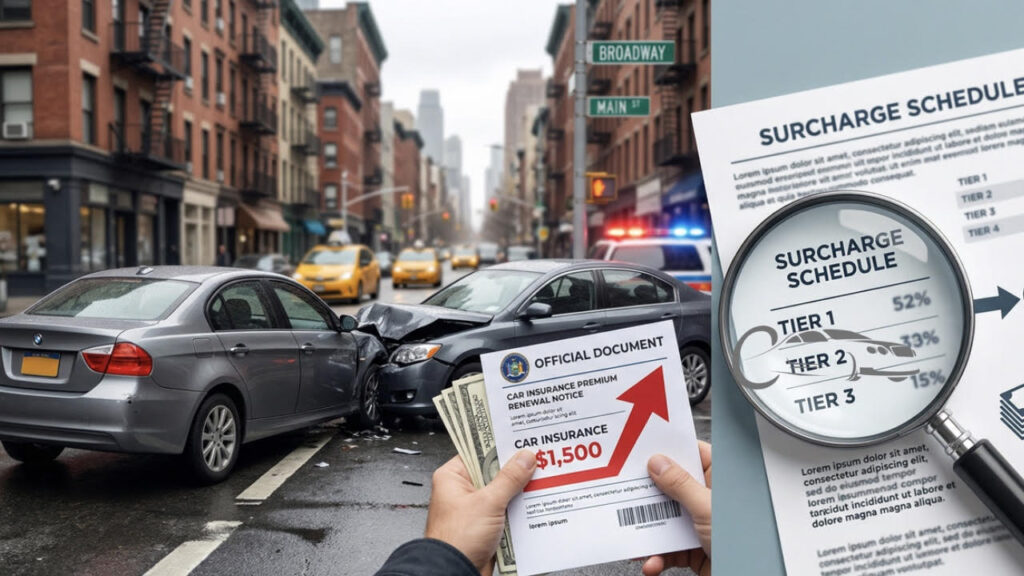
A car insurance surcharge is a penalty added to your premium following a qualifying incident — most commonly an at-fault accident or a serious traffic violation. In New York, surcharges are not arbitrary; they are governed by a structured system that determines exactly how much your rate can increase, for how long, and under what circumstances.
If you have recently been involved in an accident in New York, understanding the surcharge system is critical. The increase in your premium can be substantial, and it can last for several years — but there are also protections, exemptions, and strategies that many policyholders are unaware of.
Read also: Minimum Liability Insurance New York 2026: The Complete Guide Every Driver Needs
How New York’s Surcharge System Works
New York operates under a filed rating system, meaning insurers must submit their surcharge schedules to the New York State Department of Financial Services (DFS) for approval. This means your insurer cannot arbitrarily decide how much to penalize you — their surcharge plan must follow approved guidelines.
Surcharges are typically triggered by:
- An at-fault accident resulting in bodily injury or property damage above a set threshold
- Certain moving violations (speeding, reckless driving, DUI/DWI)
- A combination of minor incidents within a defined lookback period
The surcharge is applied at your next policy renewal following the incident and remains on your record for a period defined by the insurer’s approved schedule — typically three to five years.
The New York Safe Driver Insurance Plan (SDIP)
Many New York insurers use the Safe Driver Insurance Plan (SDIP) as the basis for their surcharge calculations. Under the SDIP, drivers accumulate points based on accidents and violations. These points directly influence premium adjustments at renewal.
How SDIP Points Are Assigned
| Incident Type | SDIP Points |
|---|---|
| At-fault accident — property damage only (under $2,000) | 1 point |
| At-fault accident — property damage only (over $2,000) | 2 points |
| At-fault accident — bodily injury involved | 3 points |
| At-fault accident — fatality involved | 4 points |
| Minor moving violation (e.g., failure to yield) | 1 point |
| Speeding 1–10 mph over limit | 1 point |
| Speeding 11–20 mph over limit | 2 points |
| Speeding 21–30 mph over limit | 3 points |
| Reckless driving | 3 points |
| DUI / DWI (first offense) | 4 points |
| Leaving the scene of an accident | 4 points |
Note: Point values and surcharge schedules vary by insurer. Your carrier’s filed rate plan governs the exact premium impact.
How Points Translate to Premium Increases
While exact percentages depend on your insurer’s approved schedule, the general pattern across New York carriers is as follows:
| SDIP Point Total | Approximate Premium Increase |
|---|---|
| 0 points | No surcharge — base rate applies |
| 1 point | 5% – 15% increase |
| 2 points | 15% – 25% increase |
| 3 points | 25% – 40% increase |
| 4 points | 40% – 60% increase |
| 5+ points | 60%+ increase; possible non-renewal |
These are representative ranges. Your actual increase depends on your insurer, your coverage type, your base premium, and your overall driving history.
How Long Does a Surcharge Last in New York?
Under New York law and standard SDIP guidelines, incidents are typically reviewed over a three-year lookback period. This means:
- An at-fault accident that occurred three or more years ago generally will not count against you at renewal
- Some insurers use a five-year lookback for more serious incidents, such as DUI/DWI or accidents involving bodily injury
- Points from multiple incidents within the lookback window are cumulative — two separate minor incidents can push you into a higher surcharge tier
Once the incident ages out of the lookback window, your premium should return toward your base rate, assuming no new qualifying events occur.
What Counts as “At-Fault” in New York?
New York is a no-fault insurance state, which creates an important distinction that many drivers misunderstand. Under no-fault rules, your own Personal Injury Protection (PIP) coverage pays for your medical expenses and lost wages regardless of who caused the accident. However, no-fault status does not eliminate the concept of fault for purposes of property damage liability or surcharge determinations.
For surcharge purposes, your insurer will make an independent fault determination based on:
- Police reports and accident reports
- Statements from all parties involved
- Photos, witness accounts, and any available video evidence
- Traffic laws applicable to the circumstances (right-of-way violations, failure to yield, etc.)
New York follows a comparative negligence standard. If you are found to be even partially at fault, a surcharge may still be applied — though some insurers have thresholds, such as requiring you to be more than 50% at fault before a surcharge is triggered.
Accident Forgiveness in New York
Many major insurers operating in New York offer accident forgiveness programs, either as a standard policy feature or as an optional endorsement. Under accident forgiveness:
- Your first at-fault accident within a defined period (typically five years) will not trigger a surcharge
- Some programs extend to a first accident in your lifetime with that insurer
- Accident forgiveness is generally available only to drivers who have maintained a clean record for a qualifying period
It is important to note that while accident forgiveness prevents a premium surcharge with your current insurer, the at-fault accident may still appear on your motor vehicle record (MVR) and could affect quotes from other carriers if you switch.
The Minor Accident Exemption
New York regulations include a minor accident exemption that may protect you from a surcharge in certain low-severity situations. Generally, an accident may be classified as minor and exempt from surcharge if:
- Total property damage is below the insurer’s defined threshold (often $2,000 or less)
- No bodily injury claims were filed
- You have no other accidents or violations within the lookback period
If you believe your accident qualifies as minor, review your insurer’s filed surcharge schedule — which is a matter of public record through the DFS — and confirm how the incident has been classified on your policy.
Your Right to Challenge a Surcharge
If you believe a surcharge has been applied incorrectly, you have options under New York law:
1. Dispute the fault determination. Contact your insurer in writing and request a review of how fault was assigned. Provide any supporting documentation — photos, police reports, witness statements, or dash cam footage.
2. File a complaint with the DFS. The New York State Department of Financial Services accepts complaints from policyholders who believe a surcharge was improperly applied or that their insurer has not followed its filed rating plan. Complaints can be submitted at dfs.ny.gov.
3. Request arbitration. In cases involving fault disputes with another driver’s insurer, the Arbitration Forums, Inc. system handles inter-company arbitration for accident claims in New York. If the arbitration finds the other party at fault, the surcharge applied to your policy may be rescinded.
4. Consult a licensed insurance agent or attorney. A broker or attorney with experience in New York insurance disputes can identify whether your insurer has applied its surcharge schedule correctly and advise on the most effective path forward.
How a Surcharge Affects Different Coverages
A post-accident surcharge typically applies to your total premium, but the impact is not uniform across all coverage types:
| Coverage Type | Surcharge Impact |
|---|---|
| Bodily Injury Liability | High impact — primary surcharge target |
| Property Damage Liability | High impact |
| Collision | High impact — especially for at-fault collisions |
| Comprehensive | Generally not surcharged (non-collision events) |
| Personal Injury Protection (PIP) | Moderate impact, varies by insurer |
| Uninsured Motorist | Moderate impact |
| Medical Payments | Low to no impact |
Understanding which coverages are surcharged can help you evaluate whether adjusting your coverage levels at renewal is a financially sound decision — though always weigh the risks of reducing coverage carefully.
Practical Steps After an At-Fault Accident
Immediately after the accident: Document everything thoroughly. Photographs, police report numbers, witness contact information, and a written account of events while your memory is fresh will all be valuable if you later dispute a fault determination or surcharge.
Within the first 30 days: Notify your insurer as required by your policy. Failure to report in a timely manner can complicate your claim and potentially affect your coverage. Review your current policy for any accident forgiveness provisions before assuming a surcharge is inevitable.
At renewal: Carefully review your renewal declaration page. If a surcharge has been applied, verify it aligns with your insurer’s filed rate plan. Compare quotes from other carriers — in some cases, switching insurers after an incident results in a lower overall premium even with the accident on your MVR.
Ongoing: Maintain a clean driving record for the remainder of the lookback period. Avoid additional violations, as cumulative points can move you into significantly higher surcharge tiers. Consider a defensive driving course — New York’s Point and Insurance Reduction Program (PIRP) can reduce both your DMV points and qualify you for a mandatory 10% premium discount for three years.
New York’s Point and Insurance Reduction Program (PIRP)
The PIRP is a state-approved defensive driving program that offers two significant benefits:
- Up to 4 DMV points removed from your driving record (which affects license suspension thresholds, not directly insurance surcharges)
- A mandatory 10% discount on your liability and collision premiums for three years, which your insurer is required by law to apply
PIRP courses are available in-person and online, typically cost between $25 and $75, and take approximately six hours to complete. While PIRP does not remove an at-fault accident from your insurance record or eliminate a surcharge already assessed, the 10% discount can partially offset the increased premium.
Frequently Asked Questions
How long will a surcharge stay on my New York car insurance? Most surcharges are based on a three-year lookback period, though serious incidents like DUI may be reviewed over five years.
Does New York’s no-fault law protect me from a surcharge after an accident? No — no-fault governs injury claim payments, not fault determinations for surcharge purposes.
Can my insurer cancel my policy because of an at-fault accident? Mid-term cancellation for a single at-fault accident is generally not permitted; however, your insurer may choose not to renew your policy at the end of the term.
Will an accident surcharge apply to all my vehicles on the same policy? Typically yes — surcharges are applied at the policy level, affecting the overall premium rather than only the vehicle involved.
Does filing a claim always trigger a surcharge? No — filing a claim does not automatically result in a surcharge; fault must first be determined.
What if the other driver was uninsured and I used my own coverage? Using uninsured motorist coverage for a not-at-fault accident should not trigger a surcharge, though you should confirm this with your insurer.
Can I shop for new insurance after an accident to avoid the surcharge? Yes, but the at-fault accident will appear on your MVR and may affect quotes from new carriers as well.
What is the minimum property damage threshold that triggers a surcharge in New York? Thresholds vary by insurer but are commonly set around $2,000 for property-damage-only accidents.
Does a PIRP defensive driving course remove my surcharge? No — it does not remove the surcharge, but it entitles you to a mandatory 10% premium discount for three years.
How do I find out my insurer’s exact surcharge schedule? Your insurer’s filed rate plan is available through the New York State Department of Financial Services at dfs.ny.gov.
Will an accident surcharge affect my umbrella policy? An auto accident may indirectly affect umbrella pricing at renewal, particularly if your underlying auto premiums increase significantly.
If another driver is found at fault, will I still be surcharged? If you are found not at fault, no surcharge should be applied — though you should monitor your renewal to confirm.
This article is for informational purposes only and does not constitute legal or insurance advice. Premium increases and surcharge rules vary by insurer and individual policy terms. Consult a licensed New York insurance professional or attorney for guidance specific to your situation.