
Table of Contents
Introduction
If you’ve ever stared at a Florida auto insurance quote and wondered why there’s a line item called “PIP” and why it costs what it does, you’re not alone. Personal Injury Protection, universally shortened to PIP, is one of the most misunderstood yet consequential pieces of any Florida driver’s insurance policy. It’s the coverage that pays your medical bills after a crash without waiting for anyone to prove who was at fault. It’s also the coverage that Florida’s legislature has been actively debating eliminating since 2021 and which, as of 2026, is still the law of the land.
This guide breaks down everything Florida drivers need to know about PIP insurance in 2026: what it actually covers, what it costs on average, what factors drive your premium up or down, how it compares to the bodily injury liability coverage that may eventually replace it, and what smart coverage decisions look like in a year when the system itself may be on the verge of a historic overhaul.
Whether you’re buying your first Florida policy, renewing after a rate increase, or trying to understand a denial letter from your insurer, this is the guide you need.
What Is PIP Insurance in Florida?
Personal Injury Protection is a form of first-party auto insurance coverage. “First-party” means it pays benefits to you, the policyholder rather than to someone else you may have injured in a crash. This is the fundamental distinction that defines Florida’s no-fault auto insurance system.
Under a traditional at-fault (or “tort”) insurance system, the driver who caused the accident is responsible for paying the other party’s medical bills. Victims must either wait for the at-fault driver’s insurer to accept liability or file a lawsuit to recover their costs. In states with no-fault systems like Florida, that waiting game is largely eliminated for medical expenses. You turn to your own PIP coverage immediately, regardless of who caused the crash.
Florida has operated under a mandatory no-fault PIP framework since 1972. The goal was straightforward: reduce the volume of auto accident lawsuits clogging the state’s courts and ensure that injured drivers and passengers could access medical care quickly. Over five decades later, the system has evolved significantly and not without controversy but the core structure remains intact as of early 2026.
Every owner or registrant of a private passenger motor vehicle in Florida must carry a minimum of $10,000 in PIP coverage. This is not optional, and it cannot be waived. Failure to maintain PIP results in a license and registration suspension, a reinstatement fee, and potential gaps in coverage that could cost you far more than the premium itself.
What Does Florida PIP Insurance Cover?
Understanding what PIP pays for and equally importantly, what it does not pay for is the first step toward building a policy that actually protects you.
Medical Expenses
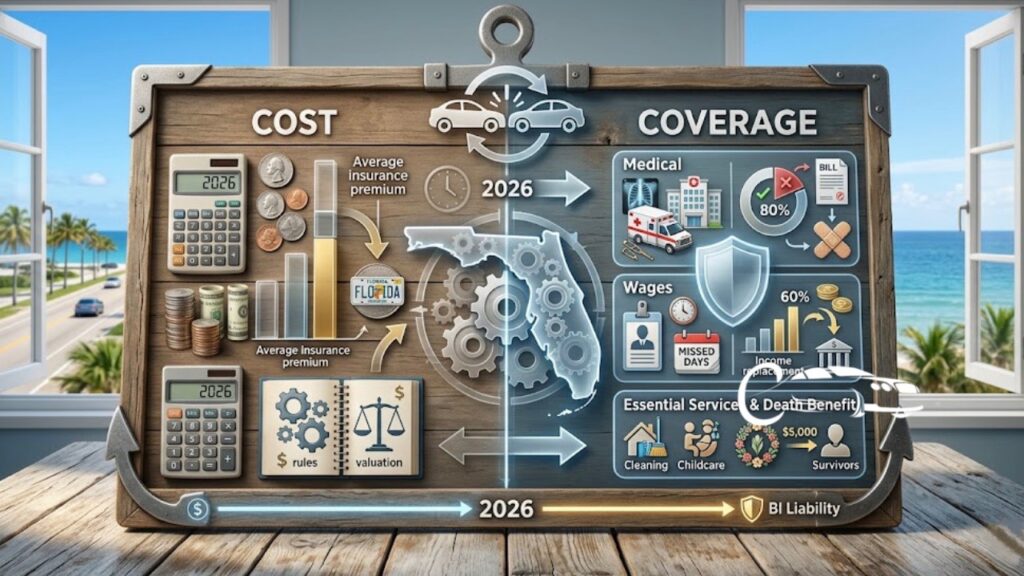
PIP covers 80% of all reasonable and necessary medical expenses resulting from an auto accident, up to the policy’s $10,000 limit. This includes emergency room visits, hospitalization, surgeries, diagnostic imaging, follow-up physician care, physical rehabilitation, and prescription medications directly related to the accident injury.
There’s an important catch embedded in this coverage: if your condition is not classified as an emergency medical condition (EMC) by a licensed physician, the total PIP benefit available for your non-emergency treatment is capped at just $2,500 and not $10,000. This distinction matters enormously. A whiplash injury that isn’t formally documented as an EMC by your treating physician can see your entire medical benefit exhausted in one or two specialist visits.
Lost Wages
If your injuries prevent you from working, PIP reimburses 60% of lost gross income, subject to the overall $10,000 limit. This reimbursement applies only to wages lost during the period your physician certifies you are disabled from performing your regular occupational duties. Self-employed individuals must document income loss through tax records or business records.
The 60% figure is a deliberate design choice, it’s high enough to provide meaningful support without creating a financial incentive to extend a recovery period unnecessarily.
Death Benefits
Florida PIP policies include a $5,000 death benefit that is payable to the estate of a covered person who dies as a result of injuries sustained in a covered accident. This benefit is separate from and in addition to the $10,000 medical and disability limit, meaning the total available benefit under a standard PIP policy can technically reach $15,000 in a fatal accident scenario.
Essential Services
PIP also covers essential services, tasks the injured person would normally perform for themselves or their household but can no longer perform due to accident-related injuries. This can include childcare, housekeeping, lawn maintenance, and similar domestic responsibilities. The reimbursement rate is modest and subject to the overall policy limit, but it provides meaningful relief during recovery.
Who Is Covered Under Your PIP Policy?
Your PIP coverage extends beyond just you as the named insured. It also covers:
- Resident relatives living in your household, including a spouse and dependent children, when they are injured in an auto accident regardless of which vehicle they were in
- Passengers in your vehicle at the time of the accident, if they do not have their own PIP coverage
- You, if you are struck by a vehicle as a pedestrian or while riding a bicycle
This broad coverage scope is one of PIP’s genuine strengths, particularly for families with multiple drivers or households where children may be passengers in various vehicles.
What PIP Does NOT Cover
Understanding PIP’s exclusions is just as important as understanding what it covers. Many Florida drivers discover these gaps at the worst possible moment, when they’re trying to file a claim.
Pain and suffering is the most significant exclusion. PIP is purely an economic benefit. It reimburses you for actual financial losses, medical bills and lost wages but it does not compensate you for the physical pain, emotional distress, or reduced quality of life that often accompanies a serious injury. Under Florida’s no-fault framework, you can only pursue pain and suffering compensation through a lawsuit if your injuries meet the statutory threshold for a “serious injury” (discussed in detail below).
Vehicle damage is entirely outside the scope of PIP. Your car, truck, or SUV is covered under separate collision or property damage coverage. PIP exclusively covers bodily injury to people.
Massage therapy and acupuncture are specifically and explicitly excluded from PIP reimbursement under Florida Statute §627.736. Even if prescribed by a physician as part of a treatment plan, these therapies are not reimbursable under PIP.
Treatment initiated more than 14 days after the accident is not covered. This is one of the most consequential rules in the entire PIP framework, and one that trips up far too many injured Floridians. The clock starts ticking the moment the accident occurs. If you do not seek medical evaluation within 14 days whether because you assumed your injuries were minor, because you were managing other post-accident responsibilities, or for any other reason, you forfeit your PIP benefits entirely.
Services from unlicensed providers are not reimbursable. All treating providers must be properly licensed in the state of Florida, and billing must conform to the state’s PIP fee schedule.
How Much Does PIP Insurance Cost in Florida?
PIP is a mandatory component of every Florida auto policy, so its cost is baked into your overall premium but insurers do itemize it separately on most declarations pages, making it possible to evaluate. Understanding what drives PIP costs helps you make smarter coverage and carrier decisions.
Average PIP Premium in Florida (2026)
Florida consistently ranks among the most expensive states in the country for auto insurance, and PIP is a significant contributor to that distinction. For 2026, Florida drivers can expect to pay approximately:
| Driver Profile | Estimated Annual PIP Premium |
| Clean record, good credit, 30–50 age range | $180 – $320 |
| One at-fault accident in past 3 years | $280 – $480 |
| Poor credit score (below 580) | $350 – $600 |
| Young driver (under 25) | $290 – $550 |
| Senior driver (over 70) | $210 – $400 |
These figures represent PIP-only costs and will vary significantly by insurer, ZIP code, and the specific coverage options selected. Drivers in Miami-Dade, Broward, and Palm Beach counties typically see PIP premiums at the higher end of these ranges due to elevated claim frequencies, medical provider fraud activity, and litigation density in South Florida.
Why Is PIP So Expensive in Florida Compared to Other States?
Florida’s PIP premiums are materially higher than the national average for PIP or equivalent medical coverage in other states. Several structural factors explain this premium:
Medical provider fraud has been a persistent and well-documented problem in Florida’s PIP ecosystem. Staged accidents, inflated medical billing, and “PIP mills” clinics that exist primarily to bill insurance companies for phantom or exaggerated treatments cost Florida insurers hundreds of millions of dollars annually. Those costs are passed directly to consumers through higher premiums. The Florida Division of Insurance Fraud handles thousands of PIP-related fraud cases every year.
High litigation rates compound the problem. Florida has historically had one of the highest rates of auto insurance litigation in the country. Attorney involvement in PIP claims drives up claim settlement costs, which insurers again recover through premiums.
Assignment of Benefits (AOB) abuse the practice of medical providers requiring injured patients to sign over their PIP benefits as a condition of treatment, then billing insurers directly at inflated rates, further inflates claim costs. Legislative reforms in recent years have curtailed some of the most egregious AOB practices, but the problem has not been fully resolved.
Population density and accident frequency in Florida’s major metropolitan areas means more accidents, more claims, and higher overall system costs than in less populated states.
Key Factors That Affect Your PIP Premium
While the structural issues above affect everyone’s PIP costs broadly, individual premium variation comes down to a specific set of rating factors that differ by insurer.
Your Driving Record
This is the single most controllable factor in your PIP premium. A clean driving history, no at-fault accidents, no moving violations, no DUIs consistently produces the lowest available rates. A single at-fault accident can increase your PIP premium by 30–60% depending on the insurer and the severity of the crash. Two incidents within a three-year period can push you into the high-risk category with some carriers, triggering even steeper increases.
Your Credit-Based Insurance Score
Florida permits insurers to use credit-based insurance scores as a rating factor. This is distinct from your credit score used by lenders, though both are influenced by similar underlying factors: payment history, outstanding debt, length of credit history, and credit mix. Studies cited by the Florida Office of Insurance Regulation have consistently shown a statistical correlation between credit-based insurance scores and claim frequency, which is why insurers use the metric.
In practical terms, a driver with excellent credit can pay 40–60% less for the same PIP coverage than a driver with poor credit, all else being equal. If your credit score has improved since your last renewal, it’s worth shopping your policy or asking your current carrier to re-rate.
Geographic Location
Where you garage your vehicle in Florida has an outsized impact on PIP premiums. South Florida — particularly Miami-Dade, Broward, and Palm Beach counties consistently generates the highest PIP rates in the state due to fraud concentration and accident density. Moving from Miami to Orlando or Jacksonville, while keeping everything else identical, can reduce your annual PIP premium by hundreds of dollars.
Even within a single metro area, rates can vary significantly by ZIP code. This is why online quote tools that ask for your full address, not just your city, produce more accurate estimates.
Age and Driving Experience
Insurers apply age-based surcharges that reflect actuarial claims data. Teen drivers and those under 25 pay significantly more for PIP coverage because young drivers are statistically involved in more accidents. The premium penalty for youth typically begins to ease around age 25 and reaches its lowest point in the 35–55 age range. Rates for drivers over 70 may rise again slightly, though less sharply than the youth surcharge.
Vehicle Type and Usage
The vehicle you drive affects PIP pricing in ways that are less intuitive than you might expect. Because PIP covers people, not the car, a vehicle’s make and model matters less for PIP than for collision or comprehensive coverage. What matters more is how the vehicle is used: a personal vehicle used exclusively for commuting is rated differently than one used for rideshare driving or business purposes. Commercial use almost always triggers higher PIP costs or requires a separate commercial policy.
Coverage Selections
Florida law sets a $10,000 minimum for PIP, but many drivers and some financial advisors recommend purchasing higher limits if they are available through their insurer and health insurance coverage is limited or absent. Some insurers offer PIP limits of $20,000 or higher in Florida, though these products have become less common as the legislative future of PIP has become uncertain. Adding a PIP deductible (typically available in $250, $500, or $1,000 increments) can reduce your premium but increases your out-of-pocket exposure after a crash.
PIP vs. Bodily Injury Liability: Understanding the Difference
One of the most common points of confusion for Florida drivers is the relationship between PIP and Bodily Injury (BI) liability coverage.
PIP is first-party coverage, it protects you and your passengers when you are injured in an accident, regardless of fault.
Bodily Injury liability is third-party coverage, it protects other people when you are at fault in an accident and injure them. BI pays for the other driver’s and passengers’ medical bills, lost wages, and in some cases pain and suffering damages, up to your policy’s BI limits.
Historically, Florida did not require drivers to carry bodily injury liability. Under the minimum coverage requirements in effect for most of the past decade, a Florida driver only needed $10,000 PIP and $10,000 Property Damage liability, no BI required. This created a significant coverage gap: if you were injured by an at-fault driver who carried only the Florida minimums, that driver had no BI coverage to pay your bills beyond what your own PIP provided.
As of 2026, and pending final resolution of the legislative debate over PIP’s repeal, BI requirements in Florida remain in transition. Drivers purchasing new policies or renewing existing ones should explicitly discuss BI limits with their agent, as the landscape is actively evolving. Adding BI coverage or increasing existing BI limits is one of the most impactful steps Florida drivers can take to protect their financial interests.
The 14-Day Rule: The Most Expensive Mistake Florida Drivers Make
It deserves its own section. Florida Statute §627.736 is explicit: to qualify for PIP medical benefits, you must receive initial medical treatment within 14 days of the accident. Not 15 days. Not “as soon as possible.” Fourteen calendar days, starting with the day of the accident.
This rule was enacted as part of the 2012 PIP reform legislation, largely in response to claims fraud involving delayed treatment that was difficult to tie causally to a specific accident. The intent was to reduce fraud. The effect, in practice, has also been to eliminate legitimate claims from drivers who delayed care for perfectly understandable reasons.
Common scenarios where the 14-day rule causes real harm:
- You feel sore after a crash but assume it’s minor muscle strain and decide to “wait and see” only to have symptoms worsen after day 14
- You’re managing immediate post-accident priorities (reporting to work, handling vehicle repairs, coordinating with the other driver) and delay a medical visit
- You don’t have a primary care physician and struggle to get a timely appointment within 14 days
- You’re uncertain whether your symptoms are accident-related and hesitate to “make a big deal” out of it
The financial consequence of missing this window is severe: your insurer has no obligation to pay any PIP medical benefits, regardless of the severity of your injuries or the clarity of the accident’s role in causing them.
The practical guidance is simple and non-negotiable: if you are in an auto accident in Florida, seek medical evaluation within 14 days. This is true even if you feel fine at the time of the crash. Whiplash, soft tissue injuries, and some neurological injuries from accidents may not produce full symptoms for 24–72 hours. A same-day or next-day visit to an urgent care clinic, emergency room, or your primary care physician protects your PIP eligibility and creates a contemporaneous medical record documenting the accident’s impact on your health.
When Can You Sue Despite No-Fault Coverage? The Serious Injury Threshold
Florida’s no-fault framework limits your ability to sue the at-fault driver for pain and suffering damages in most accident scenarios. But the statute carves out an exception for what it defines as serious injuries. If your injuries meet this threshold, you can step outside the no-fault system and pursue a tort claim for non-economic damages including pain and suffering, emotional distress, and loss of consortium.
Under Florida law, a “serious injury” for PIP threshold purposes includes:
- Significant and permanent loss of an important bodily function
- Permanent injury within a reasonable degree of medical probability, other than scarring or disfigurement
- Significant and permanent scarring or disfigurement
- Death
Meeting this threshold in practice requires thorough and consistent medical documentation. “Permanent” injuries must be established by a treating physician to a reasonable degree of medical probability, a legal standard that requires more than a doctor saying something “might” be permanent. The documentation must be contemporaneous, detailed, and consistent throughout the treatment record.
This is one of the primary reasons Florida plaintiffs’ attorneys emphasize prompt and consistent medical treatment after auto accidents: the same documentation that protects your PIP claim also builds the evidentiary record needed to pursue a tort claim if your injuries ultimately meet the serious injury threshold.
The Legislative Future of PIP: What Florida Drivers Should Know in 2026
No discussion of PIP insurance in Florida in 2026 would be complete without addressing the ongoing legislative effort to repeal the no-fault system entirely.
Florida’s legislature has debated PIP repeal in multiple sessions over the past several years. The argument for repeal rests on the assertion that PIP, as currently structured, has failed to deliver on its original promises: it hasn’t meaningfully reduced litigation (Florida remains one of the most litigious auto insurance states in the country), it hasn’t reduced fraud (PIP fraud remains a significant problem), and it hasn’t produced lower premiums (Florida rates are among the nation’s highest). Proponents of repeal argue that transitioning to a mandatory bodily injury liability system would more effectively align incentives and reduce system costs.
Senate Bill 1256, which passed the Florida legislature in 2025 and proposed eliminating PIP effective July 1, 2026, and replacing it with mandatory bodily injury liability requirements of $25,000 per person and $50,000 per accident, ultimately died in committee. As of early 2026, PIP remains Florida law.
However, the legislative trajectory is clear: PIP repeal is not a fringe proposal. It enjoys substantial support in both chambers and has come close to passage multiple times. Florida drivers should expect that another repeal effort will arise in the next legislative session and should be actively preparing for what a post-PIP coverage environment would look like.
If PIP is eventually repealed and replaced with mandatory BI coverage, the most significant practical impact on average Florida drivers would be:
- You would no longer have automatic first-party medical coverage after an accident. If you were injured and not at fault, you would need to pursue the at-fault driver’s BI policy for medical bill reimbursement is a process that can take months and may require legal assistance.
- Health insurance would become far more important as a backstop for accident-related medical costs. Drivers without robust health coverage would face significant exposure.
- Uninsured/Underinsured Motorist (UM/UIM) coverage would become an even more critical purchase, as it would provide protection when the at-fault driver carries insufficient BI limits or no coverage at all.
- Medical Payments (MedPay) coverage, an optional, limited first-party medical coverage would likely grow in popularity as a partial replacement for PIP’s immediate-care function.
The strategic implication for 2026: if you’re building or rebuilding a Florida auto insurance policy this year, do so with the assumption that PIP’s days may be numbered. Ensure you have health insurance that covers accident-related injuries, purchase UM/UIM coverage at meaningful limits ($100,000/$300,000 at minimum), and seriously evaluate whether MedPay coverage makes sense for your household.
How to Reduce Your PIP Premium Without Sacrificing Coverage
Given PIP’s mandatory status and Florida’s persistently high insurance costs, finding legitimate ways to reduce your PIP premium is a practical priority for most drivers. Here are the most effective strategies.
Shop your policy every renewal cycle. Florida’s insurer market is competitive, and pricing varies significantly from carrier to carrier for identical coverage. The driver who has been with the same insurer for five years without comparison shopping is almost certainly overpaying. Use independent agents or online comparison platforms to benchmark your current rates annually.
Maintain or improve your credit. Because credit-based insurance scores have such a significant impact on Florida PIP premiums, systematically improving your credit and paying down revolving balances, correcting errors on your credit report, avoiding new hard inquiries can produce meaningful premium reductions over 12–24 months.
Consider adding a PIP deductible. Florida allows PIP deductibles of $250 or $1,000 in most cases. A $1,000 deductible meaningfully reduces your premium and is a reasonable tradeoff for drivers who have an emergency fund sufficient to cover out-of-pocket costs in a minor accident.
Bundle your auto policy with homeowners or renters insurance. Florida insurers consistently offer multi-policy discounts of 5–15% on auto coverage, including the PIP component.
Ask about usage-based or telematics programs. Major Florida insurers including State Farm (Drive Safe & Save), Progressive (Snapshot), and Allstate (Drivewise) — offer programs that monitor driving behavior via a mobile app or plug-in device and reward safe driving with premium discounts. For drivers who brake smoothly, avoid late-night driving, and drive moderate distances, these programs can reduce overall premiums by 10–30%.
Maintain a consistent coverage history. Gaps in auto insurance coverage, even short ones, signal elevated risk to insurers and can result in higher premiums. Maintaining continuous coverage, even if you’re in between vehicles, preserves your rate tier with most carriers.
Frequently Asked Questions About PIP Insurance in Florida
Does PIP cover my passengers? Yes. If a passenger in your vehicle does not have their own PIP coverage (i.e., they are not a named insured or resident relative on any Florida auto policy), your PIP will cover their injuries up to your policy’s limit.
Does PIP apply if I’m in a rental car? Generally, yes, Florida PIP coverage follows the insured person, not the vehicle. If you are injured in a rental car accident while your Florida personal auto policy is in force, your PIP should apply to your injuries, subject to the terms of your specific policy.
What happens if my medical bills exceed $10,000? Once your PIP limit is exhausted, your health insurance becomes the primary payer for additional medical costs, subject to your health plan’s deductibles, copays, and network restrictions. If the accident was caused by another driver, you may also have a claim against their bodily injury liability coverage (if they carry it) for costs exceeding your PIP limit.
Can I be dropped by my insurer for filing a PIP claim? Florida law restricts non-renewal and cancellation based solely on a single claim, but insurers do consider claim history as a rating factor. Multiple PIP claims within a short period can lead to higher premiums or, in some cases, a carrier’s decision not to renew a policy.
Does PIP cover injuries from hit-and-run accidents? Yes. Because PIP is first-party coverage that pays regardless of fault, it applies whether the other driver stays at the scene, leaves, or is never identified.
What is the difference between PIP and MedPay? Medical Payments (MedPay) coverage is an optional, typically lower-limit first-party medical coverage that pays 100% of covered medical expenses (not 80% like PIP) with no lost wage component. It is not a substitute for PIP under Florida law, you must still carry PIP but it can serve as a useful supplement to fill the 20% medical expense gap that PIP leaves uncovered.
Building the Right Florida Auto Insurance Policy in 2026
PIP is the mandatory foundation, but a smart Florida auto insurance policy builds meaningfully beyond the minimums. Here is a framework for coverage decisions that makes sense in the current environment.
Start with the required $10,000 PIP minimum, but immediately supplement it with comprehensive health insurance if you don’t already have it. PIP’s $10,000 limit is inadequate for any serious injury, and the transition away from no-fault that Florida appears to be moving toward makes personal health coverage even more critical.
Add bodily injury liability coverage at limits of at least $100,000 per person and $300,000 per accident. Florida doesn’t mandate BI, but carrying it protects your personal assets if you cause an accident that seriously injures another person, and it positions you for the post-PIP environment that may arrive within the next legislative session or two.
Purchase uninsured/underinsured motorist coverage at matched BI limits. Florida has one of the highest rates of uninsured drivers in the country estimates consistently place the uninsured driver population between 20% and 26% of all Florida motorists. UM/UIM coverage is the only reliable protection against the significant population of drivers on Florida roads who carry no liability coverage at all.
If your vehicle is financed or leased, add comprehensive and collision coverage as required by your lender, along with GAP coverage to protect against the difference between your vehicle’s actual cash value and your outstanding loan balance in a total loss.
Finally, seriously evaluate MedPay coverage as a PIP complement. A $5,000 MedPay policy costs relatively little and fills the 20% medical expense gap PIP leaves uncovered, ensuring you face no out-of-pocket costs for covered medical treatment up to that limit.
Conclusion
PIP insurance in Florida is simultaneously straightforward in concept and complex in execution. It’s a mandatory, first-party medical coverage that gives you immediate access to funds for accident-related medical bills and lost wages but it comes with strict eligibility rules, meaningful coverage limits, significant fraud-driven premium pressures, and a legislative future that remains genuinely uncertain as of 2026.
Understanding PIP, what it covers, what it costs, what factors drive your premium, and where its gaps lie is not optional for any financially responsible Florida driver. It’s the foundation on which every other coverage decision in your auto policy rests.
The most important steps you can take in 2026: seek medical care within 14 days of any accident, shop your policy at every renewal, supplement PIP with meaningful BI, UM/UIM, and health coverage, and stay informed about the legislative changes that could fundamentally reshape Florida’s auto insurance requirements before the next time you renew.
This article is for informational purposes only and does not constitute legal or insurance advice. Coverage terms, limits, and regulations are subject to change. Consult a licensed Florida insurance agent or attorney for guidance specific to your situation.